The difference between price and value in crypto
Price is what the market quotes you today; value is what an asset can actually deliver. Confusing the two drives most bad decisions in crypto. Here is how to tell them apart.
Originally published Mar 30, 2026
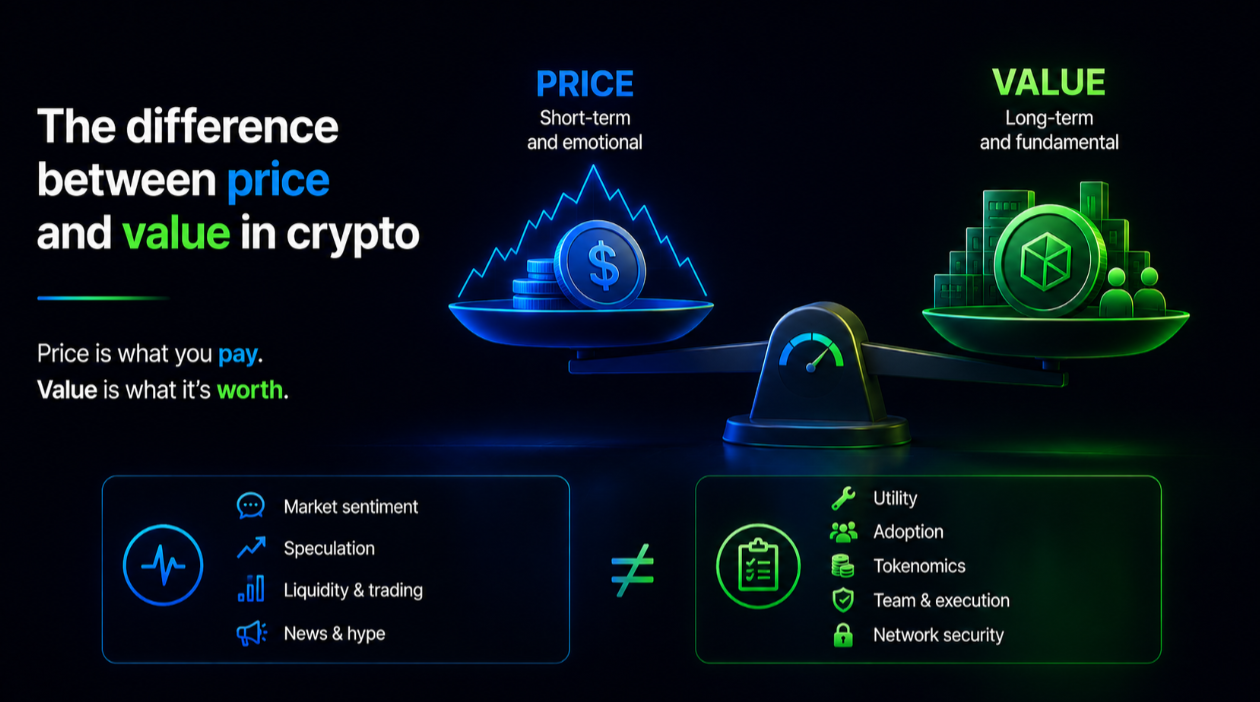
The difference between price and value in crypto
Every open exchange shows you a single number that updates several times a second, and it is dangerously easy to mistake that number for the truth about an asset. It is not. Price is a real-time voting record: the last agreed transaction between one buyer and one seller. Value is the far slower question of what an asset can actually do, secure, or produce over time. In efficient, well-covered markets the two stay close enough that most people never need to separate them. Crypto is not that kind of market. It is thin, reflexive, narrative-driven, open around the clock, and populated by participants operating on wildly different time horizons and levels of information. Under those conditions price and value can diverge for months or years, and the gap itself becomes one of the most useful pieces of information available to a disciplined investor.
The thesis here is simple to state and hard to live by: price is what you pay, value is what you get, and treating a moving price as a verdict on value is the root cause of most avoidable losses in the space. Chasing a token because the chart is green, dumping a sound protocol because the chart is red, and anchoring to the number you happened to buy at are all versions of the same error. The remedy is not a secret indicator. It is the ability to form an independent estimate of value, to understand who is setting the price at the margin, and to read large gaps between the two as questions to investigate rather than signals to obey.
Why price and value are not the same thing
Price is an emergent property of order flow. At any instant it reflects the highest bid someone is willing to post and the lowest ask someone is willing to accept, and the printed number is simply where those two most recently met. Price is therefore a statement about supply and demand right now, about liquidity, positioning, leverage, and sentiment, not a considered judgement about future cash flows or utility. A token can trade sharply higher on a wave of forced short-covering while nothing about the underlying protocol has changed, and it can bleed lower during a broad deleveraging even as adoption quietly grows. The 2022 collapses of Terra and later FTX dragged down the prices of unrelated, technically healthy protocols simply because leveraged holders had to sell whatever was liquid to meet margin calls. The price moved; the value of those bystander networks did not.
Value, by contrast, is an estimate you have to construct. For a crypto asset it usually rests on some combination of the fees the protocol can generate, the monetary premium a network commands as a store of value or settlement layer, the security budget that protects it, and the credibility of its supply schedule. None of these is quoted on a screen. You derive them from on-chain data, tokenomics, competitive position, and honest assumptions about the future. Because value is an estimate and price is a fact, people gravitate to price. It feels objective and requires no work. That is exactly the trap.
The practical consequence is that price and value answer different questions. Price answers what the market will pay you for this asset in the next few seconds. Value answers what the asset is likely to be worth if you can hold it through the noise. Confusing the two means letting a short-horizon, emotion-laden mechanism dictate a long-horizon decision. Keeping those two questions separate is what distinguishes investing from trading.
Why crypto markets diverge from value for so long
Traditional equity markets have armies of analysts, mandatory disclosures, and decades of valuation convention pulling price back toward some defensible estimate of value. Crypto has almost none of that machinery, and several structural features actively push price away from value and hold it there. The first is reflexivity, in George Soros's sense: price movements change the fundamentals they are supposed to reflect. A rising token price attracts developers, liquidity, media attention, and integrations, which genuinely improve the network, which pushes the price higher still. The loop runs in reverse on the way down, as falling prices drain liquidity, stall development, and trigger the very insolvencies the market feared. Because perception feeds back into reality, there is no fixed anchor for price to snap back to, and trends overshoot value badly in both directions.
The second feature is the market's thinness and emotional composition. Much of crypto's float is held by retail participants trading on narrative and social proof, and a meaningful share of activity is leveraged. Thin order books mean a modest amount of capital can move price a long way, and perpetual-futures leverage means those moves cascade through liquidations that have nothing to do with any protocol's fundamentals. A cluster of liquidation levels sitting just below spot can turn a routine 5 percent dip into a 30 percent cascade, as each liquidation sells into the next, purely a function of positioning. Markets that never close give sentiment no cooling-off period, so fear and greed compound overnight and over weekends. Layer reflexive narratives on top, the flippening, the supercycle, this time is different, and you get long stretches where price tracks the story rather than the substance.
The third feature is the difficulty of valuation itself. Many tokens have no cash flows, ambiguous claims on protocol revenue, opaque or inflationary emission schedules, and large allocations vesting to insiders on schedules the market half-ignores until unlock day. When a token releases a double-digit percentage of its supply to early investors in a single cliff, the marginal seller changes character overnight, yet the price often drifts higher right up to the event as if it were not coming. When the honest answer to what something is worth is a wide range, price is free to roam within and beyond that range for a long time before reality forces a reckoning. The absence of a tight value anchor is not a bug you can trade around; it is the environment you operate in.
The marginal buyer sets the price, and that changes everything
One of the most under-appreciated ideas in markets is that price is set by the marginal buyer and seller, not by the average holder. The vast majority of a token's supply may sit in the wallets of long-term believers who would never sell at current levels, and they are irrelevant to today's price. Price is determined entirely by the small sliver of supply that actually changes hands, and therefore by whoever is most motivated to transact at the margin. Once you know who that participant is, a lot of otherwise baffling price action starts to make sense.
During euphoric phases the marginal buyer is often a late, leveraged, momentum-driven trader with a short time horizon and a low pain threshold, precisely the buyer most likely to become a forced seller when the trend turns. That is why tops are violent: the marginal holder has weak hands and borrowed money. During capitulation, the marginal seller is someone being liquidated, redeeming from a fund, or simply exhausted, dumping supply into a thin bid regardless of value. In both cases the printed price is being set by the most desperate participant in the room, not by anyone weighing fundamentals. On-chain data makes this legible in a way equities rarely allow: you can watch coins that have not moved in years stay dormant through a crash while short-term holders churn, which tells you the selling is coming from weak hands, not conviction holders reassessing worth.
This also reframes what a holder base means. An asset whose marginal buyers are patient, conviction-driven, and unleveraged will hold value far more stubbornly through drawdowns than one propped up by hot money, even if their charts looked identical on the way up. When you evaluate a token, ask not only who owns it but who is likely to be transacting at the margin when conditions change. The answer tells you how price will behave relative to value under stress, which is exactly when it matters.
Price is set by the most desperate person willing to trade, not the most thoughtful person choosing to hold, which is exactly why the crowd is loudest at the moments it is most wrong.
How to form an independent view of value
You cannot judge whether price is high or low relative to value unless you have your own estimate of value first, one you formed before you looked at the chart. That estimate does not need to be precise; a defensible range is enough, and often more honest than false precision. The goal is a thesis robust enough that a screaming red or green candle refines it rather than overturns it. Anchor your view to things that move slowly and can be measured, not to sentiment.
- Real usage and cash flows: fees paid by users, protocol revenue, active addresses, and whether that activity is organic or bought with token incentives that will eventually stop. A protocol paying out more in emissions than it earns in fees is subsidising its own usage, and that flatters every metric until the subsidy ends.
- Tokenomics and supply schedule: circulating versus fully-diluted valuation, emission and inflation rates, insider and treasury allocations, and upcoming unlock cliffs that will add sellers. A token that looks cheap on circulating supply can be expensive once the fully-diluted picture and the vesting calendar are in view.
- Security and credibility: the economic cost to attack the network, how decentralised the validators or miners are, and whether the monetary policy is genuinely credible and hard to change. A supply cap that a small group of insiders could vote to raise is not really a cap.
- Competitive moat: switching costs, liquidity depth, developer mindshare, and integrations, the things that would let the network keep its users if a well-funded rival launched tomorrow with identical features.
- Downside case: what the asset is worth if the current narrative is wrong, so you know how much of the price is story and how much is substance before you commit capital.
Different assets demand different lenses, and applying the wrong one is a common mistake. A settlement layer or store-of-value network is better judged on security, credibility of supply, and monetary premium than on a price-to-fees multiple; forcing a cash-flow model onto it produces a number that looks rigorous and means nothing. A DeFi protocol that returns real revenue to token holders can be assessed more like a cash-flow business, with attention to whether that revenue is durable or a temporary subsidy that vanishes when incentives dry up. A governance token with no claim on cash flows and heavy emissions may have very little fundamental floor at all, and pretending otherwise is how people talk themselves into holding through a slow bleed toward zero.
Hold your estimate loosely, but hold it
An independent view is not a fixed target you defend to the death; it is a living hypothesis you update as evidence arrives: a shipped upgrade, a security incident, a change in fee trajectory, a competitor's rise. The discipline is to update on facts about the asset, not on the price of the asset. If the price falls but your value estimate is unchanged or higher, that is potentially opportunity, not vindication of the sellers. If the price rises while the fundamentals deteriorate, that is risk, not confirmation you were right. Keeping those two update channels separate is the entire game.
Reading the gap as information, not as a signal
When price and your value estimate diverge sharply, the instinctive reaction is to treat the gap as a trade: buy when price is far below value, sell when it is far above. Sometimes that is correct, but treating the gap as an automatic signal is how thoughtful investors get run over. The market can stay irrational longer than you can stay solvent, and a large gap in either direction is first and foremost a question. What does the market know, fear, or hope that my model does not capture?
So when you find a wide divergence, interrogate it before acting. If price is far below your value estimate, ask whether the market is pricing in a risk you have discounted: a looming unlock, a regulatory overhang, a smart-contract or bridge vulnerability, a founder problem, or simply a broad liquidity drought that spares nothing. If price is far above your estimate, ask what future the buyers are underwriting, whether that future is plausible, and how much reflexive momentum is holding the price up that could reverse the moment inflows slow. Often the investigation reveals that the market is seeing something real and your value estimate was the thing that needed updating. That is the gap doing its most valuable job, cheaply correcting your model before your capital pays the tuition.
When the gap survives that scrutiny, when you have genuinely accounted for the risks and the divergence still looks like emotion rather than information, you have found the rare situation where an independent view pays off and where it may make sense to act against the crowd. Even then, position sizing and time horizon matter more than being right, because you can be correct about value and still be early by a painful margin. Size so a prolonged divergence cannot force you out, and remember that none of this is financial advice. It is a way of thinking, and every crypto asset carries the risk of permanent, total loss.
Pay attention to price, but answer to value
The screen will always show you price, and price will always feel like the most important number in the room. The skill that separates durable investors from the churn of the crowd is the ability to treat that number as one input, a real-time readout of supply, demand, positioning, and emotion, rather than as a verdict. Price tells you what the marginal, often most desperate, participant will pay right now. Value tells you what you might actually get if you can hold through the noise. Both matter, but only one of them should steer long-horizon decisions.
In a market as reflexive and thin as crypto, the two can drift apart for a very long time, and that drift is not a malfunction to resent. It is the source of opportunity for anyone willing to do the work of forming an independent estimate and reading large gaps as questions rather than commands. Build your own view of value, understand who is setting the price at the margin, update on facts and not on candles, and let the difference between what you pay and what you get become the thing you study rather than the thing that studies you.
Frequently asked questions
What is the difference between price and value in crypto?+
Price is the number quoted on an exchange right now, the last transaction between a buyer and seller, driven by supply, demand, sentiment, and leverage. Value is an estimate of what an asset can actually deliver over time, such as protocol fees, security, and a credible supply schedule. Price is a fact you can read off a screen; value is a judgement you have to construct. In crypto the two can diverge for long periods.
Why does crypto price often diverge from fundamentals for so long?+
Crypto markets are thin, trade around the clock, and are heavily influenced by leverage and narrative. Prices are also reflexive: a rising price attracts developers, liquidity, and attention that genuinely improve the network, which pushes the price higher still, and the loop runs in reverse on the way down. Because many tokens are hard to value precisely, price is free to overshoot fundamentals in both directions before reality forces a correction.
What does 'the marginal buyer sets the price' mean?+
Price is determined only by the small share of supply that actually changes hands, not by the average holder. Most coins may sit with long-term believers who never sell, so they do not affect today's price. Whoever is most motivated to transact at the margin, a leveraged momentum trader near a top or someone being liquidated near a bottom, is setting the printed price, which is why extreme moves reflect positioning and emotion more than fundamentals.
How do I estimate the value of a crypto asset?+
Start before you look at the chart and build a defensible range rather than a single number. Look at real usage and cash flows (fees and revenue, and whether they are organic), tokenomics and the supply schedule (inflation, fully-diluted valuation, and upcoming unlocks), security and the credibility of monetary policy, and the competitive moat. Use the right lens for the asset type: judge a settlement layer on security and monetary premium, and a revenue-sharing DeFi protocol more like a cash-flow business.
Should I buy when price falls far below my estimate of value?+
Not automatically. A large gap between price and your value estimate is first a question, not a signal. The market may be pricing in a risk you missed, such as an unlock, regulatory issue, or contract vulnerability. Investigate the gap, and often you will find your estimate needed updating. Only when the divergence survives that scrutiny does acting against the crowd make sense, and even then, size positions so a prolonged gap cannot force you out. This is not financial advice.
Is a rising crypto price proof that a project is good?+
No. A rising price can be driven by short-covering, leverage, hype, or reflexive momentum with no change in the underlying protocol. Treating a green chart as confirmation of quality is one of the most common mistakes investors make. Judge a project by facts about the asset, such as usage, revenue, security, and tokenomics, and update your view on those facts rather than on the price itself.
How this was reported
ChainWatch Daily is independent and reader-funded. Stories are written by named journalists and checked against primary sources before publishing. We disclose holdings, correct errors in the open, and never accept payment for coverage.
More like this
Bitcoin ETFs Swing Back to Positive as Crypto Market Holds Near $3 Trillion
U.S. spot Bitcoin ETFs have erased a $5.8 billion deficit to turn positive for 2026, while the broader crypto market holds near $3 trillion with sentiment firmly in "Greed" territory
Bitcoin Falls Below $84K as Hot US PMI Data Meets Bitget's $352M Hack
A stronger-than-expected US PMI reading reignited Federal Reserve rate-hike bets and pulled Bitcoin back below $84,000, just as crypto exchange Bitget confirmed a $352 million breach it now blames on North Korean hackers.
Bitcoin Holds Steady as Trump-Xi Summit Looms and BitMEX Shuts Down
As Bitcoin consolidates above $86,000 ahead of a high-stakes Trump-Xi meeting, the crypto derivatives pioneer BitMEX has closed its doors for good after eleven years in the market.