Stablecoins are becoming plumbing. Here’s what regulators want next
Once a stablecoin settles real payments at scale, it stops being a trading chip and becomes financial infrastructure. That shift is what regulators are now writing rules to govern.
Originally published Apr 20, 2026
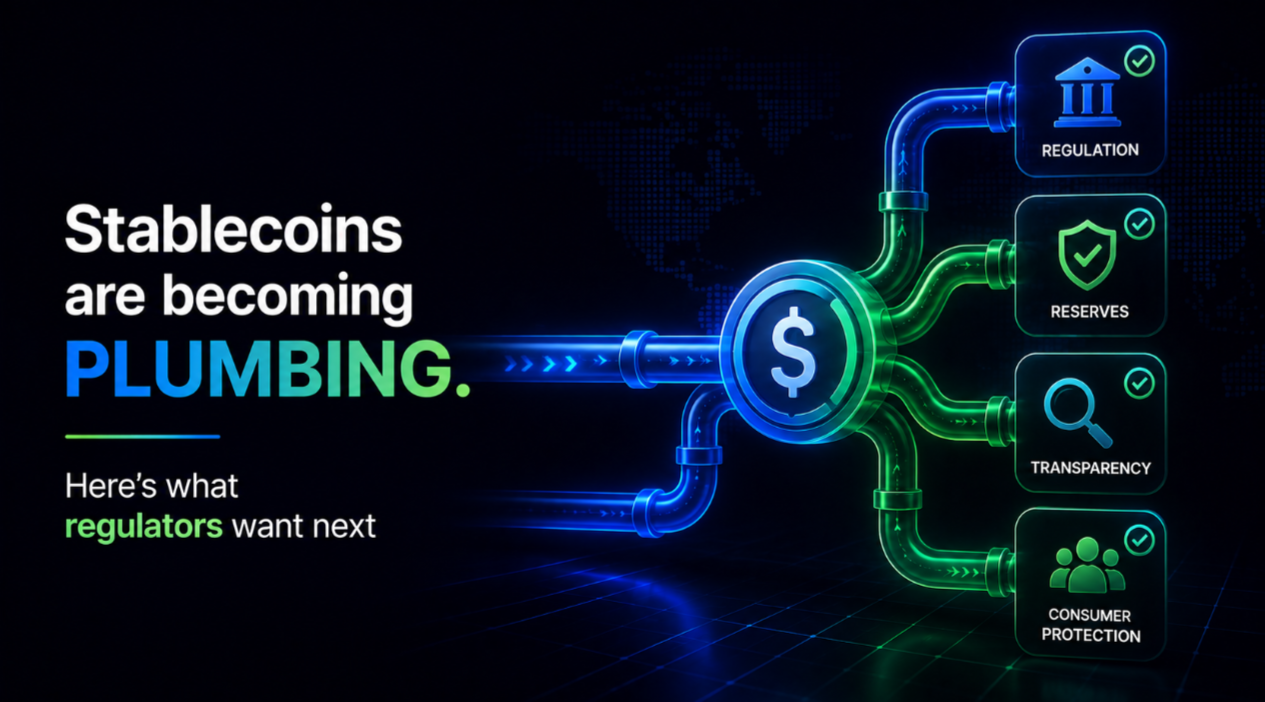
Stablecoins are becoming plumbing. Here’s what regulators want next
For most of their history, stablecoins were treated as a crypto-native convenience. You parked value in them between trades, moved dollars between exchanges over a weekend, and skipped the friction of the banking system. That framing is out of date. When a single token clears large volumes of merchant settlements, remittances, treasury flows and on-chain collateral every day, it has stopped being a niche trading instrument and started doing the job of a payment rail. And once something behaves like a rail, the people who supervise payment systems, banks and money-market funds begin asking it the questions they ask of anyone who holds the public's money and promises to give it back on demand.
The claim of this piece is simple: stablecoins are becoming plumbing, and plumbing gets regulated like plumbing. The live debate is no longer whether these instruments should exist. It is how they must be built. What backs them. Who can redeem them, on what terms, and how fast. What happens to holders when the issuer fails. The direction of travel across the major jurisdictions is broadly consistent even where the fine print diverges, and it matters because the rules now being drafted will quietly decide which issuers survive, which business models get killed off, and who ends up controlling the dollar's on-chain plumbing. None of what follows is investment advice. It is an attempt to explain the machinery and the fights around it.
Reserves and attestation: the difference between a claim and a promise
The core promise of a fiat-backed stablecoin is that one token equals one dollar, redeemable at par. Almost the entire regulatory apparatus being built around these instruments is an effort to make that promise verifiable instead of merely asserted. The first lever is the reserve itself. Regulators broadly want reserves held in high-quality, liquid assets: cash at supervised banks and short-dated government paper, rather than commercial paper, corporate bonds, secured loans or, worst of all, the issuer's own crypto holdings. The logic is duration and liquidity. If every holder can demand a dollar at once, the assets behind those dollars have to be sellable at close to par at once too. A reserve stuffed with longer-dated or illiquid instruments can look perfectly solvent on a spreadsheet and still fail to meet redemptions in the hours that actually decide a panic.
The second lever is proof. For years, issuers published 'attestations': a firm confirming that reserves existed at a snapshot in time. That is weaker than it sounds. An attestation is not an audit. It typically does not opine on internal controls, does not verify that the assets are unencumbered rather than pledged elsewhere, and says nothing about the days between snapshots, which is precisely when a reserve gets raided or rehypothecated. The regulatory push is toward more frequent and more granular reserve reporting, plainer disclosure of what actually sits in the reserve line by line, and in some regimes a move toward genuine audit-grade assurance. The distinction is not academic to a corporate treasurer deciding whether to hold nine figures of a token overnight.
Why 'fully backed' is not one thing
Two issuers can both call themselves fully backed and present completely different risk. Picture a reserve made almost entirely of overnight government repo and Treasury bills held with segregated custodians. Now picture one holding a slice of corporate paper plus deposits concentrated at a single bank. Both may show assets equal to liabilities to the penny. But the first can meet a wave of redemptions by letting bills mature or selling into the deepest market on earth, while the second faces mark-to-market losses and counterparty concentration at the exact moment it can least afford either. Rules that prescribe reserve composition are not box-ticking. They are an attempt to make 'backed' mean the same thing from one issuer to the next, so the word carries information instead of marketing.
Redemption at par under stress: the whole game
A stablecoin is only as good as its worst redemption day. In calm markets almost any structure holds its peg, because arbitrageurs mint and redeem to close small gaps and pocket the spread. The real test is a stress event: bad news, a custodian wobble, or simply one large holder heading for the exit while everyone else decides not to be last in line. This is a classic run, identical in shape to a bank run or a money-market fund breaking the buck. If redemption is fast, cheap and reliable at exactly one dollar, the peg stabilises itself, because arbitrage stays profitable and pulls the price back. If redemption is slow, gated, fee-laden or restricted to a handful of institutional partners, ordinary holders cannot reach par directly. They have to dump the token on the open market instead, which pushes the price below a dollar and confirms the very fear that started the run.
That is why supervisors are increasingly focused on the mechanics of redemption, not just the existence of a reserve. The mechanics come down to a few sharp questions. Who has the legal right to redeem at par, everyone or only whitelisted partners? How quickly must the issuer pay, in what form, and can that window stretch during exactly the stress it is meant to survive? Can the issuer impose gates or fees, and who decides when? A design where only a few authorised participants can redeem at par shoves all the pressure onto the secondary market, and a broken peg on-chain becomes self-fulfilling as holders watch the number drift and rush to sell. Recent years supplied the live example: a widely held stablecoin briefly lost its peg because part of its reserve was trapped at a failing bank, and confidence evaporated in hours even though the shortfall was ultimately covered.
A stablecoin does not have to be insolvent to fail. It only has to make holders doubt they can get their dollar back this afternoon.
Bankruptcy-remote structures: what happens if the issuer dies
Reserves and redemption govern the running system. Bankruptcy-remoteness governs the ending. Suppose the issuing company fails outright, whether through fraud, mismanagement, a ruinous legal judgment, or simply running out of operating cash. The question that decides whether holders are made whole is deceptively technical: are the reserve assets the property of the token holders, or are they assets of the company that its general creditors can seize? If reserves sit on the issuer's balance sheet as ordinary corporate assets, holders become unsecured creditors in a bankruptcy queue, ranking behind secured lenders and waiting years for cents on the dollar. If reserves are legally segregated, held in trust, in bankruptcy-remote vehicles, or in custody where holders have a direct claim, then those assets are ring-fenced from the issuer's own creditors and can, in principle, be returned to holders while the company is wound down around them.
This is why the clearer regimes insist on structural separation: reserves kept apart from the operating business, ideally with holders owning a legal claim on them. It is one of the least glamorous corners of stablecoin regulation and one of the most consequential. Two tokens can trade at a dollar apiece today and be entirely different instruments in a crisis, and the difference is buried in the legal wrapper around the reserve rather than anything visible on-chain. The trade-off is real. Segregation adds cost and operational complexity, limits what an issuer can do with the float, and cuts the yield the issuer gets to keep. That tension over who captures the reserve income drives several of the open fights below.
Fiat, crypto and algorithmic: three backings, three risk profiles
Not every stablecoin is the same instrument wearing the same label, and regulators treat the categories very differently. The cleanest way to sort them is by where the risk actually lives:
- Fiat-backed, with off-chain reserves. Each token is backed by dollars and dollar-equivalent assets held in the traditional financial system. The peg is strong because redemption is a direct claim on real reserves, but the model imports the risks of the banks and custodians holding those reserves, plus the issuer's honesty about what it holds. Those are exactly the risks attestation and segregation rules are written to contain.
- Crypto-collateralised, on-chain and over-collateralised. The token is backed by a surplus of volatile crypto locked in smart contracts, deliberately over-collateralised so the buffer absorbs price swings. This is transparent and hard to censor, but it is capital-inefficient and exposed to sharp crashes, where falling collateral triggers automated liquidations that dump assets into a thin market and push prices lower still, threatening the next tranche of loans in a cascade.
- Algorithmic and undercollateralised. The peg is defended by code and incentives, often a companion token that expands and contracts supply, rather than by held reserves. These have failed catastrophically more than once, because the mechanism runs on continued market confidence. When confidence goes, the same design that was supposed to defend the peg accelerates the collapse into a 'death spiral' instead of arresting it, as the companion token is inflated toward zero in a doomed attempt to buy the peg back.
The regulatory instinct that came out of this history is to privilege reserve-backed models with real, liquid, segregated assets, to tolerate transparent over-collateralised crypto designs within limits, and to be openly hostile to algorithmic stablecoins that promise a stable dollar with nothing solid underneath. That is not taste. It reflects which designs have actually held par when tested and which have vaporised billions in holder value the first time they were pushed.
Why clear rules favour scale and drive consolidation
Here is the counterintuitive part. You might expect heavy regulation to punish the big incumbents hardest. In practice, clear rules tend to entrench scale. The fixed costs of compliance are enormous and largely independent of how many tokens you issue: a licence, audit-grade reserve reporting, segregated custody, legal structuring, ongoing supervision, and banking relationships willing to hold your reserves in the first place. A tiny issuer and a giant issuer pay broadly similar amounts to stand up a compliant back office, but the giant spreads that fixed cost across a vastly larger float. Regulation quietly converts a fragmented, permissionless market into one where a compliant licence is the moat.
A second, subtler force pushes the same way. Stablecoins make their money chiefly on the yield of their reserves, the interest thrown off by the government paper and deposits sitting behind the float. That is a scale business with strong network effects, because liquidity attracts liquidity: a token that is accepted everywhere and deeply traded is more useful and safer to hold than one that is not, which pulls in still more holders. Bolt a regulatory barrier to entry onto a business that already has network effects and reserve-yield economics, and the natural end state is a handful of large, licensed, boring issuers that look more like card networks or clearing houses than the free-for-all of early crypto. Whether that concentration is a feature (accountability, a supervisable point of contact) or a bug (single points of failure, gatekeeping over who gets to hold digital dollars) is a genuine open policy question, not a settled one.
The open fights: foreign issuers and yield-bearing variants
Two battles are still live, and both will shape the next few years. The first is jurisdictional. A stablecoin is global by default. A token minted under one country's rules circulates freely on-chain everywhere else, whether or not those other countries approve. That raises hard questions about foreign issuers. Should a token issued and regulated abroad be freely usable at home, or held, or offered to residents at all? Regulators worry about reserves and holders they cannot see, about a foreign-issued dollar token quietly becoming systemically important inside their economy, and about whether their own residents could actually redeem at par in a crisis when the issuer sits under someone else's legal system and someone else's courts. The tension is between the borderless nature of the technology and the stubbornly national nature of financial supervision, and different jurisdictions are landing in different places, some building recognition regimes for foreign issuers, others simply restricting access.
The second fight is about yield. A plain stablecoin passes none of the reserve's interest to holders; the issuer keeps all of it, which on a large float is a serious business in its own right. That has created intense demand for yield-bearing variants that share the reserve income with holders, and for tokens backed by tokenised money-market funds. The problem is that the moment a token pays a return based on the performance of underlying assets, it stops looking like electronic cash and starts looking like a security or a fund, which drags in a heavier body of regulation around disclosure, investor protection and what the issuer is even allowed to do. Supervisors are wary that a 'stablecoin' paying yield could smuggle money-market-fund risk into something marketed as safe as cash, and that holders chasing a few points of return may not register that they have taken on investment risk to get it. Where exactly the line falls between a permitted payment token and a regulated investment product is one of the most consequential unresolved questions in the whole space.
If you hold, build on, or accept stablecoins, the practical move is to look past the dollar on the screen and ask the plumbing questions. What actually backs this. Who can redeem it, how fast, and at what price when it matters. What happens to my claim if the issuer goes under. Two tokens both quoting one dollar can be radically different instruments once you press on those points, and the regulations now being written are, in effect, a coordinated effort to force the answers into a form a reasonable person can trust. None of this is a recommendation to buy, hold or use any particular token. It is a map of the machinery, so you can judge for yourself.
Frequently asked questions
What does it mean that a stablecoin is 'backed by reserves'?+
It means the issuer holds assets, ideally cash and short-dated government securities, equal to the value of tokens in circulation, so each token can in principle be redeemed for one dollar. Quality matters as much as quantity. Reserves in liquid, low-risk assets can meet redemptions under stress, while reserves in illiquid or risky assets may not, even when they look fully backed on paper.
What is the difference between an attestation and an audit for a stablecoin?+
An attestation is a limited confirmation that reserves existed at a specific moment. It usually does not test internal controls, verify that the assets are unencumbered, or cover the periods between snapshots. An audit is a deeper, standardised examination of financial records and controls. Regulators are pushing issuers toward more frequent reporting and audit-grade assurance because attestations alone leave large gaps.
Why did some algorithmic stablecoins collapse?+
Algorithmic stablecoins hold little or no real reserves and try to defend their peg through code and incentives, often using a companion token to expand or contract supply. That holds while markets are confident, but when confidence drops the mechanism can accelerate the fall into a 'death spiral,' where declining prices trigger more selling. With nothing solid to redeem against, holders can lose most or all of their value very quickly.
What are bankruptcy-remote reserves and why do they matter?+
Bankruptcy-remote structures hold a stablecoin's reserves legally separate from the issuing company, in trust or segregated custody, so that if the issuer goes bankrupt those assets are ring-fenced from the company's own creditors and can be returned to token holders. Without this, holders may become unsecured creditors stuck in a bankruptcy queue, waiting years and potentially recovering only a fraction of their dollar.
Are yield-bearing stablecoins legal?+
It depends on the jurisdiction and the structure. Once a token pays holders a return based on underlying assets, it can look less like electronic cash and more like a security or a fund, which triggers heavier regulation around disclosure and investor protection. Some yield-bearing designs are built as regulated investment products, while paying yield on tokens marketed as plain stablecoins faces significant regulatory resistance. This is not financial or legal advice.
Does stablecoin regulation help or hurt big issuers?+
Clear rules tend to favour large, established issuers. The fixed costs of compliance, such as licensing, audits, segregated custody and banking relationships, are largely the same regardless of size, so big issuers spread them across a much larger float. Combined with the network effects of liquidity and reserve-yield economics, this tends to drive consolidation toward a smaller number of large, licensed issuers.
How this was reported
ChainWatch Daily is independent and reader-funded. Stories are written by named journalists and checked against primary sources before publishing. We disclose holdings, correct errors in the open, and never accept payment for coverage.
More like this
Senate blocks the CLARITY Act 49–50, leaving market structure to the regulators
Cloture on the motion to proceed failed eleven votes short of sixty. The Democrats who negotiated the text voted against opening debate on it.

Stablecoin framework clears committee with reserve and audit rules attached
A stablecoin bill has advanced out of committee carrying reserve-quality, attestation and redemption rules — a framework that would legitimize the biggest compliant issuers while squeezing everyone else. Here is what it would require and where the real fights remain.

The EU’s crypto rulebook enters its next compliance phase
Europe's unified crypto framework is shifting from paper to practice, forcing exchanges, custodians and stablecoin issuers to prove they can operate under bank-style oversight or leave the market.