The MEV problem, explained without the jargon
Every on-chain trade passes through an invisible auction that decides how much value gets extracted from it. Here is how block-ordering power works, and how to defend against it.
Originally published Apr 17, 2026
The MEV problem, explained without the jargon
When you send a swap to a public blockchain, you probably imagine it travelling in a straight line: your wallet signs, the network confirms, your tokens arrive. The reality is stranger. Between the moment you hit confirm and the moment your trade lands in a block, your intention becomes public information that other parties can read, react to, and profit from. Whoever assembles the next block decides the exact order in which transactions execute, and in a system where order determines price, that ordering power is worth money. The value captured purely by choosing what goes where in a block has a name: Maximal Extractable Value, or MEV.
MEV is not an exotic edge case or a hacker exploit. It is a structural property of any transparent, ordered ledger where prices move as trades execute. Some MEV is harmless and even useful, quietly keeping prices consistent across venues. Some is a direct tax on your trade, extracted by bots that see your transaction before it settles and rearrange the block around it. Knowing the difference, and the machinery that decides which one happens to you, separates trading blind from trading with your eyes open. You do not need to be a validator or a bot operator to protect yourself, but you do need to understand the auction you are unknowingly entered into every time you swap.
The mempool: your trade goes public before it happens
On most public chains, a transaction does not go straight into a block. It first sits in a waiting area called the mempool, a shared pool of pending transactions that every node on the network can see. This waiting room exists for good reasons: it lets the network propagate transactions, lets validators choose which to include, and lets you bid for faster inclusion by attaching a higher fee. But it carries a consequence that is easy to miss. The moment your swap enters the public mempool, your exact intention is legible to anyone watching: which token you are selling, how much, on which pool, and, critically, how much price movement you have agreed to tolerate.
That last detail matters enormously. When you set slippage tolerance in a DeFi interface, you are declaring the worst execution price you will still accept. A searcher bot reading the mempool treats that number as a ceiling: it says exactly how far the price can be pushed against you before your transaction reverts. Your protective setting doubles as an instruction sheet for anyone who wants to extract value from you. This is the uncomfortable core of transparent blockchains. The same openness that lets you verify the system without trusting anyone also broadcasts your hand to the table before the cards are played.
The mempool itself is neutral. It is monitored by a spectrum of actors, from arbitrage bots that correct price discrepancies to predatory searchers hunting for large, loosely protected swaps. What people do with the information it leaks is where the ethics live, not in the pool itself.
Ordering power: why the sequence of transactions is worth money
To see why ordering is valuable, you have to understand how an automated market maker prices a trade. A typical constant-product pool holds two assets and quotes them against each other so that the product of their two balances stays roughly fixed. Buy one asset out of the pool and you shrink its balance, which forces the price up for the next buyer of that same asset in that same block. Price is path-dependent: the same three transactions produce different outcomes depending on the order they execute in. Whoever controls the order controls who gets the good price and who gets the bad one.
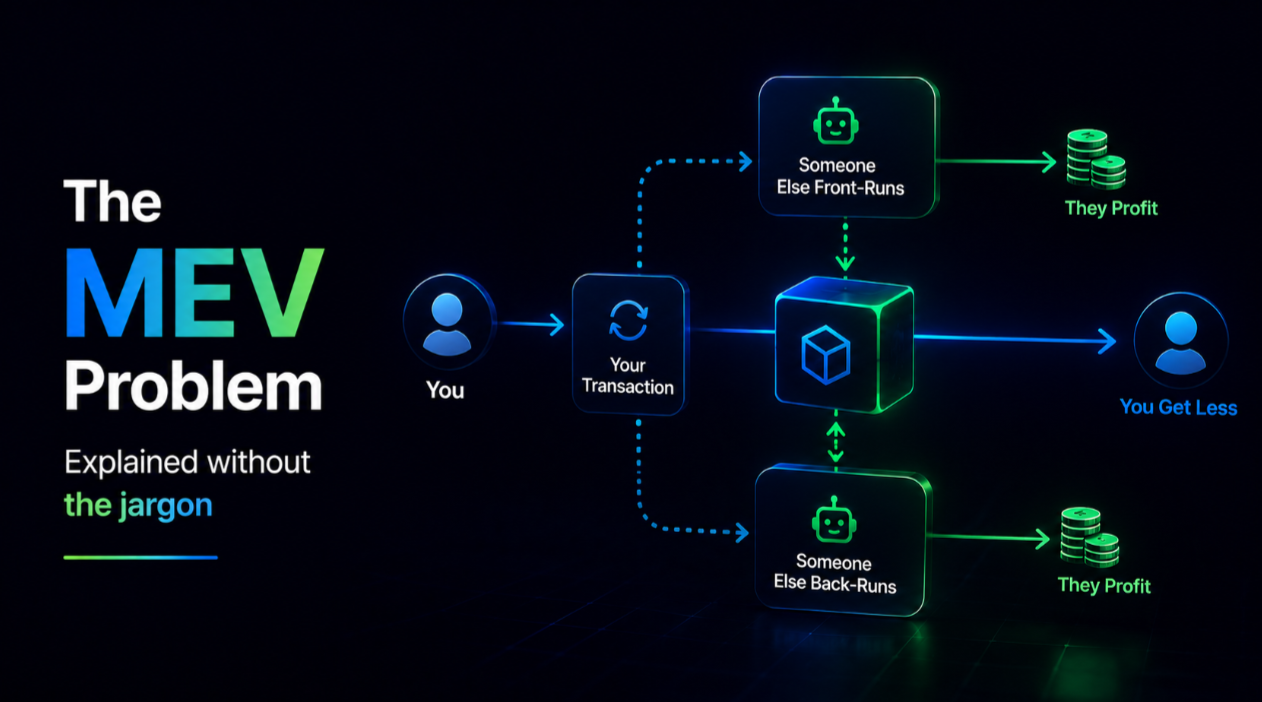
This is the raw material of MEV. If a block builder can slot their own transaction immediately before yours, they can buy into the pool, let your trade push the price further in the same direction, then sell into that inflated price, all within a single block. The profit comes not from any insight about the asset's true value but purely from the privilege of choosing sequence. In a normal market, being first requires being fast or being informed. In a block, being first is a slot that can be bought, and the auction for that slot runs on almost every transaction you send.
It helps to separate the main species of ordering-based extraction, because they are not morally equivalent:
- Benign arbitrage: a bot notices the same asset priced differently on two venues and trades to close the gap. It does not touch your specific transaction; it makes the market more efficient and is arguably a public good. It is MEV, but it is not extraction from you.
- Back-running: a searcher places their transaction immediately after a large trade to capture the price dislocation that trade creates. It does not worsen your execution; it harvests the ripple your trade leaves behind.
- Front-running: a bot sees your pending trade and rushes an identical trade in ahead of it, buying the asset cheaper so it profits as your trade moves the price. You still execute, but at a worse price than you would have.
- Sandwiching: the most predatory form. A bot places one trade right before yours and another right after, buying ahead to inflate the price you pay, then selling into the peak your trade created. You are the filling in the sandwich, and the gap between your expected and actual price is their profit.
MEV is not a bug in the system; it is the price of transparency, and the only real question is who collects it.
A worked example: how a sandwich eats your trade
Imagine you want to swap a meaningful amount of a stablecoin for a mid-liquidity token, and you set a generous slippage tolerance because failed transactions have burned you before. Your trade hits the public mempool. A bot scanning for exactly this pattern sees two things it likes: a large order against a pool shallow enough that your trade will move the price noticeably, and a slippage ceiling loose enough to give it room to work.
The bot builds a bundle. First it buys the same token just before you, nudging the price up. Then your transaction executes, buying at that already-elevated price and pushing it higher still, right up toward the ceiling your slippage setting permitted. Finally the bot sells everything it just bought into the peak your own trade manufactured. You receive fewer tokens than you would have on an untouched pool. The gap is not lost to fees or to the protocol; it is captured by the bot, and often a share is passed to whoever produced the block, because the bot had to outbid rivals for that placement. Your loose slippage was the enabling condition. Had you set it tight, the bot's front-run would have pushed the price past your limit and reverted your transaction, which is precisely why tight slippage is a defence, and also why it sometimes causes trades to fail on volatile pairs. That tension, protection versus reliability, is the trade-off every DeFi trader manages whether they realise it or not.
Proposer-builder separation: how the industry tried to tame the chaos
Left unchecked, MEV creates ugly incentives. If validators can earn extra by reordering transactions, they are motivated to run sophisticated extraction operations themselves, which concentrates power. In the worst case it tempts them to reorganise an already-produced block to steal a particularly lucrative opportunity from a past slot, a so-called time-bandit reorg that attacks the chain's own finality. When the reward for rewriting recent history exceeds the block reward, the incentive to keep the chain stable weakens. The response that emerged is a conceptual split known as proposer-builder separation, or PBS.
The idea is to divide two jobs that used to sit with one party. Specialised block builders compete to assemble the most valuable possible block, packing in transactions and MEV bundles and optimising their order. They submit sealed bids for their block to the proposer, the validator whose turn it is to extend the chain. The proposer's job shrinks to something almost mechanical: pick the highest-paying valid header and sign it, usually without seeing the block's full contents until it is committed. An intermediary called a relay sits between builders and proposers to make this handoff trustworthy, holding the full block back until the proposer has committed to it so neither side can cheat the other.
The point is not to eliminate MEV, which is probably impossible on a transparent chain, but to change who captures it and to blunt its most dangerous side effects. By letting anyone build blocks and forcing them to compete, PBS pushes a large share of MEV profit back to validators and, indirectly, to the people who stake with them, rather than letting it accrue only to whoever runs the fastest private bot. It also reduces the incentive to reorganise the chain, because the ordinary proposer no longer performs the extraction. It is a mitigation and a redistribution, not a cure, and it carries its own centralisation worry: a handful of dominant builders assembling most blocks concentrates a different kind of power, including the ability to censor which transactions get in.
Practical defences: what you can actually do
You cannot abolish MEV, but you can make yourself a far less attractive target and route around the public mempool entirely. The defences fall into a few categories, each with its own trade-off. Nothing here is financial advice, and every tool below has failure modes, so treat them as risk management rather than guarantees.
Control your slippage and split large orders
The single highest-leverage habit is to stop leaving generous slippage tolerance on by default. A tight tolerance shrinks the room a sandwich bot has to operate and causes many attacks to revert rather than succeed, at the cost of more failed transactions on genuinely volatile pairs. For large trades, breaking one big order into several smaller ones, or using a tool that does this for you, reduces the price impact of any single transaction and makes each slice less worth attacking. Trading against deep, liquid pools rather than thin ones matters for the same reason: a bot's profit scales with how far your trade moves the price, and depth is what limits that movement.
Use aggregators and private transaction routes
DEX aggregators split your trade across multiple pools and paths to minimise price impact, which incidentally makes you harder to sandwich because no single pool sees your whole order. More powerful still are private transaction routes, sometimes called private relays or protected RPC endpoints, which submit your transaction directly to block builders without ever exposing it in the public mempool. If the bots cannot see your trade before it lands, they cannot front-run or sandwich it. Some of these services go further and rebate a portion of any benign MEV your transaction generates. The trade-offs are real: you are trusting the route's operator not to misuse or delay your transaction, and inclusion can sometimes be slower than a public broadcast.
- Set slippage as tight as the pair's volatility realistically allows, rather than accepting a loose default.
- Prefer deep, liquid pools and split large orders into smaller pieces to cap price impact.
- Route trades through reputable aggregators so no single pool sees your entire order.
- Consider a private RPC or MEV-protected transaction route to keep your trade out of the public mempool.
- Be extra careful on new, thin, or hyped pairs, where low liquidity and high volatility make extraction most profitable.
The right combination depends on what you trade and how often. A long-term holder making occasional large swaps benefits most from private routes and order splitting. An active trader on liquid pairs may find tight slippage and a good aggregator sufficient. The common thread is awareness: once you know a hidden auction runs on your transactions, you stop handing it easy wins.
Trade like the auction exists
MEV feels like an obscure technicality until you realise it has quietly shaped every on-chain trade you have ever made. It is the natural consequence of putting a transparent, order-sensitive market on a public ledger where the right to sequence transactions carries monetary value. You cannot wish it away, and much of it, the honest arbitrage that keeps prices aligned across venues, you would not want to. What you can do is refuse to be the easy target. Your slippage setting is a message to bots. The public mempool broadcasts your intentions. Private routes and thoughtful order construction exist precisely to close that gap.
The infrastructure is drifting in your favour. Proposer-builder separation, MEV-aware wallets, protected RPCs, encrypted-mempool research, and smarter aggregators all push toward fairer, less extractive execution. But the tools only help people who know they exist. The invisible auction keeps running whether or not you pay attention. The difference, having read this, is that you now get to decide whether you show up to it with your cards face up or face down.
Frequently asked questions
What does MEV stand for in crypto?+
MEV stands for Maximal Extractable Value (originally Miner Extractable Value). It is the value that can be captured by whoever controls the ordering of transactions within a block, by including, excluding, or reordering them. Because prices in on-chain markets move as trades execute, the power to decide sequence is worth money, and that captured value is MEV.
Is all MEV harmful to traders?+
No. Some MEV, such as arbitrage that corrects price differences between venues, is benign and even useful because it keeps markets efficient without worsening your specific trade. The harmful kinds are front-running and sandwiching, where a bot manipulates the price around your transaction so you get a worse execution. The distinction is whether the extraction targets your trade or simply harvests broader market inefficiencies.
What is a sandwich attack and how do I avoid it?+
A sandwich attack is when a bot places one trade right before yours to push the price up and another right after to sell into the peak your trade created, pocketing the difference. You reduce your exposure by setting tight slippage tolerance, splitting large orders into smaller ones, trading on deep liquid pools, and using a private transaction route or MEV-protected RPC that keeps your trade out of the public mempool.
How does slippage tolerance relate to MEV?+
Your slippage tolerance is the worst price you will accept, and it doubles as a ceiling that tells attacking bots exactly how far they can push the price against you before your trade reverts. Loose slippage gives sandwich bots room to operate; tight slippage shrinks that room and causes many attacks to fail. The trade-off is that very tight slippage can also cause legitimate trades to fail on volatile pairs.
What is proposer-builder separation (PBS)?+
Proposer-builder separation splits block production into two roles. Specialised builders compete to assemble the most valuable block and submit sealed bids; the proposer, the validator whose turn it is, simply picks the highest-paying valid block and signs it, often via a relay that withholds the full contents until the proposer commits. This redistributes MEV profit more broadly, reduces the incentive for validators to reorganise the chain, and limits the danger of extraction being concentrated in a few private operators, though it introduces its own builder-centralisation risk.
Can MEV be eliminated entirely?+
Probably not on a fully transparent chain, because MEV arises from the basic fact that transaction order affects price and that order is visible in advance. The realistic goal is mitigation: reducing predatory forms, redistributing the value more fairly, and giving users tools like private relays and protected RPCs to shield individual trades. Research into encrypted mempools and fairer ordering aims to shrink MEV further, but a complete cure is not currently on offer.
How this was reported
ChainWatch Daily is independent and reader-funded. Stories are written by named journalists and checked against primary sources before publishing. We disclose holdings, correct errors in the open, and never accept payment for coverage.
More like this

DeFi lending TVL tops its prior-cycle high as real-world collateral expands
Total value locked in DeFi lending has climbed past its previous cycle peak, but the headline number hides a structural shift: a growing share of that collateral now lives off-chain, changing the risk in ways TVL was never built to show.

Restaking protocol caps new deposits amid concentration concerns
A leading restaking protocol has paused new deposits, a defensive move that spotlights the correlated-slashing and concentration risks lurking beneath one of DeFi's fastest-growing designs.

Decentralized exchanges capture a growing share of spot volume
On-chain venues are steadily taking spot-trading business that centralized exchanges once dominated. The mechanics of automated market makers, plus self-custody and open listing, explain why, and reveal what the shift costs traders.