Proof-of-work versus proof-of-stake, beyond the energy debate
The real gap between proof-of-work and proof-of-stake isn't watts. It's where security comes from, how misbehavior is punished, who gets to participate, and how each holds up under censorship.
Originally published Apr 11, 2026
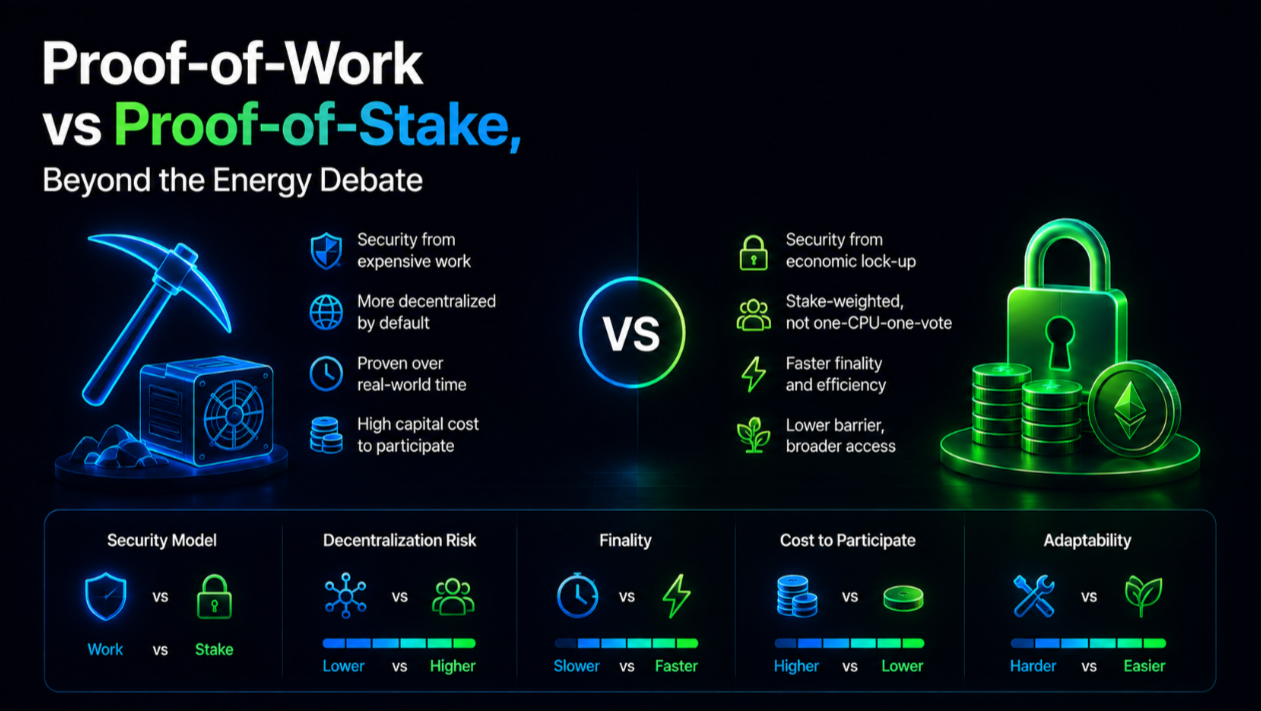
Proof-of-work versus proof-of-stake, beyond the energy debate
Almost every popular comparison of proof-of-work and proof-of-stake collapses into an argument about electricity. That framing is understandable but analytically shallow. Energy consumption is a consequence of one design choice, not the axis on which these consensus mechanisms actually differ. If you want to understand why Bitcoin and Ethereum feel like fundamentally different security models rather than two flavors of the same thing, you have to look past the power meter and ask a harder question: what is an attacker forced to spend, and what happens to them when they get caught?
The meaningful differences live in four places. The source of security — an external, real-world cost versus internal, on-chain capital. The accountability model — deterrence by sunk cost versus deterrence by confiscation. The shape of participation and how block production concentrates. And the behavior of each system under liveness pressure and censorship. Each design makes an honest trade-off. Neither is strictly superior, and anyone who tells you otherwise is usually holding the token of whichever chain they are defending. What follows lays out the mechanisms plainly so you can reason about the trade-offs yourself. None of this is financial advice.
Security from external cost versus internal capital
In proof-of-work, the cost of attacking the chain is anchored to the physical world. To rewrite history you need to out-hash the honest majority, which means acquiring or renting a large fraction of the network's hardware and paying for the electricity to run it. That cost is external to the protocol: it is denominated in machines, power contracts, cooling, and logistics that exist regardless of the coin's price. This is the deeper meaning of proof-of-work's energy use. The burn is the security. The chain is expensive to attack because producing valid blocks is genuinely, thermodynamically expensive, and that expense cannot be faked with clever accounting.
Proof-of-stake relocates the cost inside the system. Instead of burning an external resource, validators lock up the protocol's own token as a bond, and the right to propose and attest to blocks is proportional to that stake. An attacker needs to control a large fraction of the staked capital. The security budget is therefore the market value of the bonded tokens rather than a fleet of ASICs. This is elegant — it removes the ongoing energy expenditure — but it introduces a reflexivity that proof-of-work mostly avoids: the thing securing the chain is priced by the same market whose confidence depends on the chain being secure. In a severe crisis those two variables can move together in the wrong direction, because a falling token price shrinks the cost of acquiring an attacking share of stake at exactly the moment confidence is weakest.
The practical consequences of this split are worth stating plainly:
- PoW security is a recurring flow cost. Miners must keep spending on power to keep producing blocks, and an attacker faces that same ongoing bill for the full duration of an attack.
- PoS security is largely a stock of locked capital. The cost of participating is opportunity cost and lock-up risk rather than a continuous energy invoice, and much of that capital is recoverable if you behave.
- PoW hardware has salvage value and can, in principle, be redirected to attack a chain and then resold afterward. Rented hashpower makes short attacks cheaper to stage against smaller chains that share a hashing algorithm with a larger one, since an attacker can borrow capacity built for the bigger network.
- PoS capital is chain-specific. Tokens bonded to secure a given network have no use attacking a different one, which localizes risk but also concentrates it in a single asset's valuation.
Accountability: deterring by cost versus deterring by confiscation
This is where the two models diverge most sharply, and it is the difference most casual comparisons miss entirely. In proof-of-work, misbehavior is deterred by cost but almost never punished after the fact. If a miner builds on a stale block or attempts a short reorg and fails, they forfeit the block reward they would have earned. They wasted electricity, nothing more. There is no mechanism inside Bitcoin that reaches out and destroys a misbehaving miner's coins. The protocol cannot even identify the offender in a way that would let it retaliate. In the language of consensus research, proof-of-work is not accountable: you can prove the chain is valid, but you generally cannot prove who tried to cheat and impose a targeted penalty on them.
Proof-of-stake is built around exactly that missing capability. Validators sign attestations with identifiable keys tied to their bonded stake, so the protocol can detect provably malicious actions — signing two conflicting blocks at the same height, or making contradictory attestations that could enable a double-spend — and slash the offender, burning a portion of their stake and ejecting them from the validator set. Slashing turns a passive deterrent into an active punishment. An attacker in proof-of-stake doesn't merely waste resources on a failed attack; they can have their capital confiscated with cryptographic proof of guilt. This is a genuinely stronger accountability property, and it is the honest technical case for proof-of-stake that has nothing to do with energy.
Proof-of-work makes cheating expensive; proof-of-stake makes cheating punishable. One deters by burning the attacker's resources, the other by seizing them.
There is a subtle corollary about honest mistakes. Because slashing is a real weapon, running a validator carries operational risk that mining does not. A misconfigured setup that accidentally signs two conflicting messages — often from running the same validator keys on two machines for redundancy — can be penalized even without malicious intent. This is why well-designed protocols scale the penalty to how many validators fault at the same time. An isolated double-sign is treated leniently; a large, correlated batch of them — the fingerprint of an actual coordinated attack rather than a clumsy solo operator — is penalized severely, up to the near-total loss of the offending stake. That correlation-aware penalty is deliberate, and it has no analogue in proof-of-work.
Who gets to participate, and what decentralization really means
Both camps claim the decentralization high ground, and both are describing a different thing. In proof-of-work, the barrier to meaningful participation is access to competitive hardware and cheap electricity. Over time this has pushed block production toward specialized ASICs and regions with the lowest power costs, and it has concentrated a great deal of practical influence in mining pools that coordinate the output of many individual miners under one operator's block template. The permissionless promise is real — anyone can point a machine at the network — but the economics reward scale, and scale reliably centralizes. A single miner with a home rig has a vanishingly small chance of ever finding a block alone, which is precisely why pools exist and why so much hashpower routes through a handful of them.
Proof-of-stake changes the barrier from industrial to financial. You don't need a warehouse or a power contract; you need capital and the competence to run a validator reliably around the clock. This lowers some barriers — there is no geography-of-cheap-power arms race — and raises others. Staking protocols often impose a minimum bond per validator, which pushes smaller holders toward delegation, staking-as-a-service providers, and liquid-staking tokens that pool many depositors behind a single operator. Those pools then become their own centralization vector, and a large one can drift toward controlling an uncomfortable share of total stake. The uncomfortable pattern in both systems is identical in shape: whatever resource confers block-production rights tends to pool. Hashpower pools into mining pools; stake pools into staking providers and liquid-staking derivatives.
The cost of exit and the fate of an attacker
One underappreciated participation difference is what happens after a successful attack. If an attacker captures a proof-of-work network, the hardware they used still works afterward — they can keep mining or sell the rigs into the secondary market. In proof-of-stake, the social layer has an option proof-of-work lacks: if a validator cartel successfully attacks the chain, the community can coordinate a fork that writes off the attacker's stake, effectively burning the capital they used to mount the attack while leaving honest validators whole. This makes a large proof-of-stake attack potentially a one-shot, capital-destroying event rather than a repeatable exploit. But it also means the ultimate backstop is human coordination — client teams, exchanges, and node operators agreeing on which fork is canonical — rather than pure protocol math. That is a real dependency, not a rhetorical flourish, and it is worth being honest about: the last line of defense in proof-of-stake is social, and social consensus is messier and slower than a hash comparison.
Liveness, finality and censorship resistance
Consensus systems have to choose, under network stress, between always producing blocks (liveness) and never producing conflicting ones (safety). Classic proof-of-work leans toward liveness with probabilistic finality. The chain keeps extending, and a block becomes practically irreversible as more blocks pile on top, but it is never mathematically final — deep reorgs are astronomically unlikely, not impossible. This is simple and robust. The network keeps ticking as long as a single honest miner is producing blocks, reorganizations resolve by the heaviest-chain rule, and no specific validator needs to be online at any specific moment for the chain to make progress.
Many proof-of-stake designs pursue economic finality instead. After a supermajority of stake attests to a block, it is finalized, and reverting it would require an attacker to get a large fraction of stake slashed — making reversal provably costly rather than merely improbable. The price of that stronger guarantee is a stronger liveness assumption. Finalization needs a participating supermajority online; if too many validators go dark, the chain may keep producing blocks but stop finalizing them. Some designs answer this with an inactivity mechanism that gradually bleeds stake away from the absent validators until the remaining active set once again forms a supermajority and finality resumes. This is the safety-versus-liveness trade-off made concrete: proof-of-stake tends to buy faster, harder finality by accepting that finalization can stall under severe participation failures.
Censorship resistance cuts across both. In proof-of-work, whether a transaction gets included depends on miners and, increasingly, on the block-building supply chain that assembles blocks for them. In proof-of-stake, inclusion depends on validators and their block builders. Neither model is automatically censorship-proof. The real question in both is how many independent parties can produce a block, and how easily a censored transaction can eventually reach a non-censoring producer. The mechanism differs but the failure mode rhymes: a small set of specialized block builders quietly filtering transactions. That shared risk is why in-protocol inclusion guarantees — designs that force proposers to include eligible pending transactions — are an active area of work regardless of consensus flavor.
The honest trade-offs, side by side
Put the energy question aside entirely and the picture sharpens. Proof-of-work offers simplicity, an attack cost anchored to the physical world, and a battle-tested liveness model, at the price of ongoing energy expenditure, no in-protocol punishment for attackers, and an economic gravity toward hardware and pool centralization. Proof-of-stake offers accountability through slashing, sharper finality, and no continuous energy burn, at the price of security that is reflexively tied to token price, greater protocol complexity, meaningful operational risk for validators, and reliance on the social layer as a last-resort backstop.
These are not the same trade-offs dressed differently. They are different security philosophies. Proof-of-work says: make the truth expensive to counterfeit by tethering it to something scarce outside the system. Proof-of-stake says: make lying provable and punishable by tethering identity and capital inside the system. A serious analyst evaluating a chain should ask which philosophy fits its threat model, how concentrated block production actually is in practice rather than in principle, and whether the finality and censorship-resistance properties match what the applications built on top of it quietly assume.
For anyone using these networks — not trading their tokens, but relying on them to settle value — the practical takeaway is to reason about failure modes, not slogans. Ask how a transaction becomes irreversible on the chain you are using, how long you should wait before treating a payment as final, and what would have to go wrong for that assumption to break. Those questions have concrete, mechanism-level answers that differ between proof-of-work and proof-of-stake, and they matter far more to your actual risk than the electricity headline ever will. Treat this as analysis of how the systems work, not guidance on what to buy.
Frequently asked questions
What is the main difference between proof-of-work and proof-of-stake?+
The core difference is where security comes from. Proof-of-work anchors it to an external, physical cost — hardware and electricity — so producing blocks is genuinely expensive. Proof-of-stake anchors it to internal capital, requiring validators to lock up the network's own tokens as a bond. From those two choices flow nearly all the other differences, including how attackers are punished and how a transaction becomes final.
Is proof-of-stake more secure than proof-of-work?+
Neither is strictly more secure; they secure differently. Proof-of-stake adds accountability — it can detect and slash provably malicious validators, punishing attackers directly. Proof-of-work can't identify or penalize cheaters after the fact, but its attack cost is tied to the physical world rather than to a token price that can fall during a crisis. The better model depends on the threat you care about most.
What is slashing in proof-of-stake?+
Slashing is a penalty that burns part of a validator's bonded stake and removes them from the validator set when they commit a provably malicious act, such as signing two conflicting blocks. It is how proof-of-stake turns deterrence into active punishment. Well-designed protocols apply harsher penalties to large, correlated faults — the fingerprint of a coordinated attack — than to isolated operator mistakes.
Does proof-of-stake solve crypto's energy problem?+
It dramatically reduces energy use because it no longer relies on burning electricity to produce blocks. But framing the debate purely around energy misses the point: proof-of-stake introduces its own trade-offs, including security that is reflexively tied to token price, added protocol complexity, and reliance on the social layer as a final backstop against a large attacker.
What is the difference between probabilistic and economic finality?+
Probabilistic finality, typical of proof-of-work, means a transaction becomes more irreversible as more blocks are added on top, but is never mathematically final. Economic finality, used by many proof-of-stake designs, means that once a supermajority of stake attests, reverting the block would require attackers to be slashed — making reversal provably costly. The trade-off is that hard finality needs an online participating supermajority.
Can proof-of-work or proof-of-stake censor transactions?+
Both can, and neither is automatically censorship-proof. In proof-of-work, inclusion depends on miners and their block builders; in proof-of-stake, on validators and their builders. The practical question in both is how many independent parties can produce a block, so a censored transaction can eventually reach a non-censoring producer. In-protocol inclusion guarantees are being researched for both.
How this was reported
ChainWatch Daily is independent and reader-funded. Stories are written by named journalists and checked against primary sources before publishing. We disclose holdings, correct errors in the open, and never accept payment for coverage.
More like this

A major layer-2 finalizes its move to a permissionless prover set
One of Ethereum's largest layer-2 networks has opened validity-proof generation to anyone, retiring the single trusted prover that quietly sat at the center of its trust model. The change is incremental, but it removes a real chokepoint and sharpens the questions about what remains centralized.

Validators flag client-diversity risk after a single client nears supermajority
Validators are warning that one software client is edging toward a supermajority of the network — a concentration that could turn a single bug into a chain-wide failure. Here is the mechanism, the thresholds that matter, and how operators can pull the system back from the edge.

Account-abstraction wallets pass a usage milestone
Smart-account wallets have crossed a usage milestone, pushing account abstraction from a developer experiment toward a default way people hold crypto. Here is what changes, and what still doesn't.