Which stablecoin is safest to hold?
The comparisons rank on market cap and peg stability, and skip the two facts that decide the outcome: who can freeze your balance, and what kind of document the reserve report really is.
- Published
- Oct 29, 2026
- Reading time
- 10 min
- Fact-checked by
 ✓ Priya Nair
In this article
8 partsThe safest stablecoin depends on what you are protecting against, and the two risks that matter most are the two least often compared: the issuer's ability to switch your balance off, and the difference between an attestation and an audit.
Almost all of them can freeze your money
This is not an edge case. It is a routine, documented function that has been used thousands of times. Tether alone has blacklisted billions of dollars of USDT across thousands of addresses, and public dashboards track them.
That is lawful cooperation with law enforcement rather than misconduct. It is also proof of what a fiat-backed stablecoin is: a claim on a company that can turn it off. Functionally, it is a bank account with a blockchain interface — and anyone deciding where to keep money deserves to know that before they read about reserves.
Attestation is not audit
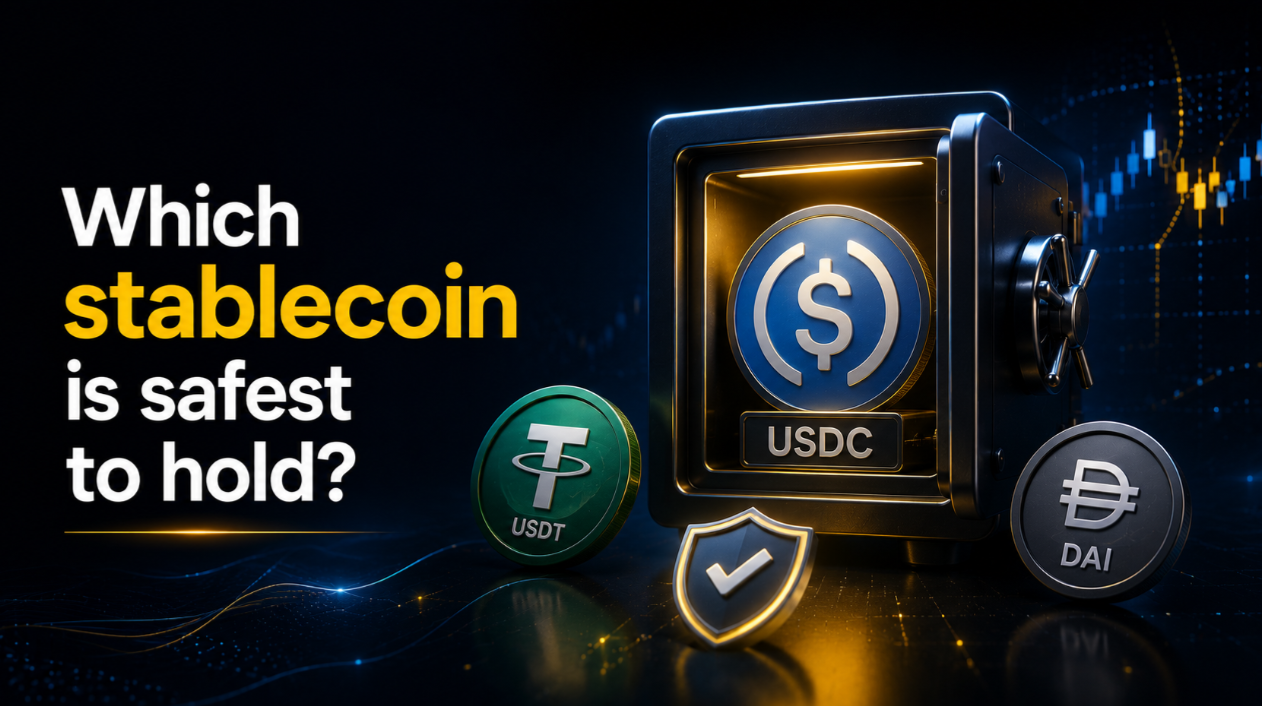
USDC is issued by Circle, a US-listed public company, which makes it the only stablecoin in our rating whose issuer files audited financial statements with a securities regulator — on top of monthly reserve attestations by a major accounting firm. Reserves are cash and short-dated Treasuries held at regulated institutions, and it is licensed under MiCA in Europe, with $73.9bn circulating across 154 chains.
USDT publishes quarterly attestations — point-in-time reports rather than a full audit, a materially weaker instrument. Composition matters as much as the total: alongside cash and Treasury bills, reserves include secured loans, bitcoin, gold and other investments, which behave very differently in a crisis than short-dated government paper.
But the better-documented one is the one that broke
In March 2023, $3.3bn of Circle's reserves were trapped at Silicon Valley Bank over a weekend. USDC traded down to about $0.87 and recovered when the US government guaranteed SVB deposits.
Full backing did not prevent the break. A government decision resolved it. Meanwhile USDT, with the weaker documentation, has never broken its peg the same way, and its record through repeated crises is better than its critics predicted. Better evidence and better price behaviour are not the same claim, and the honest answer is to hold both facts at once.
The peg you see is only as good as the venue quoting it
On 10 October 2025, USDe printed $0.65 on Binance while trading at $0.99 everywhere else — because Binance's unified-account oracle read its own $8m order book instead of the $400m of on-chain liquidity next door.
The protocol was 110% collateralised throughout. About $1bn of forced liquidations followed anyway, and roughly $8bn of supply left over the following months. Backing is not liquidity, and liquidity is not the venue you happen to be looking at.
Who earns the interest
The reserves behind the large stablecoins earn a market rate on tens of billions of dollars, and none of it reaches the holder. If you are holding six figures of stablecoins for months, you are lending an issuer money at 0% — arguably the largest quiet transfer of value in this industry.
For a working balance used for trading, that is a fair price for instant settlement. For savings, compare it honestly against a money-market fund or a Treasury bill, which pay you the interest and cannot be blacklisted by a company decision. USDS is the notable exception among large stablecoins in paying the holder at all.
How to decide
- For evidence quality: USDC. Audited public-company issuer, monthly attestations, cash and short-dated Treasuries, MiCA-licensed.
- For depth and settlement: USDT, at $183.3bn across 130 chains and the pair almost every order book quotes against. If you need to move a large amount at par at any hour, nothing else is close.
- For savings: probably neither. Compare against an instrument that pays you the interest.
- In every case: hold across more than one issuer. Every failure in this category has been issuer-specific.
A fiat-backed stablecoin is a bank account with a blockchain interface. That is not an insult — it is the specification.
The short version
USDC has the strongest evidence and has broken its peg; USDT has weaker documentation and a better price record. Both can freeze your balance and neither pays you interest. Split across issuers, keep only a working balance, and if you are holding for months rather than days, price the alternative that pays you.
Frequently asked questions
4 questionsWhich stablecoin is safest?
On evidence quality, USDC — its issuer Circle is a US-listed public company filing audited financial statements, with monthly reserve attestations over cash and short-dated Treasuries. On price record and depth, USDT, which has never broken its peg the way USDC did in March 2023. Holding across both is the sound answer.
Can a stablecoin issuer freeze my balance?
Almost all of them can, and the large ones routinely do. Tether has blacklisted billions of dollars across thousands of addresses, generally at law-enforcement request, and Circle can freeze any address and has. It is lawful cooperation rather than misconduct, and it means the balance is a claim on a company.
What is the difference between an attestation and an audit?
An attestation is a point-in-time report confirming reserves at one moment; an audit is an examination of a company's financial statements under professional standards. Tether publishes quarterly attestations; Circle publishes monthly attestations on top of audited public-company financials filed with a securities regulator.
Do stablecoins pay interest?
Almost none pay the holder. The reserves earn a market rate on tens of billions of dollars and the issuer keeps it, which for a long-held balance means lending a company money at 0%. USDS is the notable large exception. For savings rather than trading, compare against a money-market fund or Treasury bill.
About the author
Ethan Brooks is a U.S.-based Senior Crypto Analyst at ChainWatch with nearly a decade of experience analyzing digital asset markets, blockchain data, and institutional trading activity.
How this was reported
ChainWatch Daily is independent and reader-funded. Stories are written by named journalists and checked against primary sources before publishing. We disclose holdings, correct errors in the open, and never accept payment for coverage. This article is information, not financial advice.
More like this
What happened at every exchange that lost customer money
The incidents are the least interesting part. The question that separates these venues is what happened in the seventy-two hours afterwards.
Priya Nair·2d ago·9 min
What exchange insurance funds actually cover
Most cover futures liquidations, not theft. Several cannot be verified at all. One has genuinely paid out.
 Ethan Brooks·Oct 19, 2026·8 min
Is Binance safe to use?
A $4.3bn guilty plea, a proof of reserves it had to correct for overstating reserves, and a protection fund that has actually paid out. All three are true.
Priya Nair·Oct 13, 2026·9 min