Staking on an exchange: what it costs you
Coinbase pays retail 1.75% of a 2.473% network rate. The 29% it keeps is published nowhere.
- Published
- Nov 12, 2026
- Reading time
- 8 min
- Fact-checked by
 ✓ Theo Walsh
In this article
7 partsCoinbase: a 29% take, undisclosed
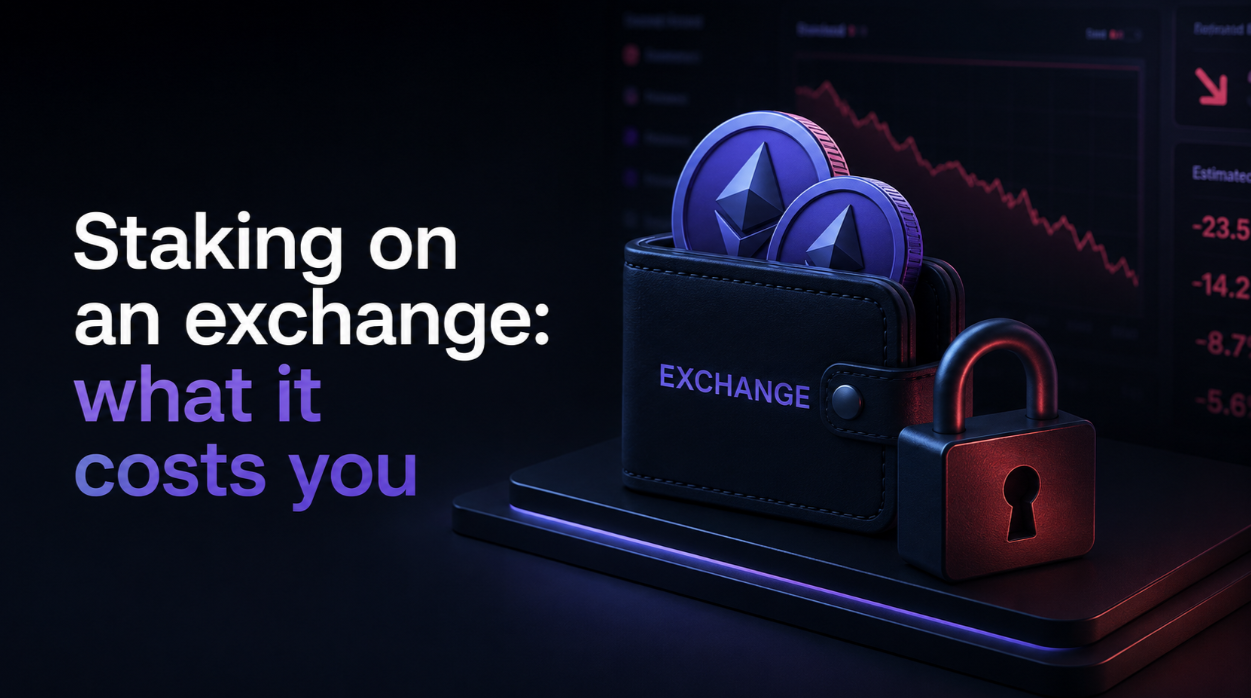
Coinbase pays retail roughly 1.75% on staked ETH. The network pays about 2.473%. The difference is an implied take of about 29%, and the take rate appears nowhere on the product — you have to derive the gross figure yourself and divide.
For comparison, Lido charges 10% and states it. Coinbase charges nearly three times as much and does not.
It does show a net number rather than a gross one, which is more honest than the alternative. But a net number without the gross figure alongside it cannot be evaluated.
Kraken: honest, in a support article
Kraken's own support documentation states that the APYs shown in the app "do not include Kraken's commission". That is a company telling you, in writing, that its headline number is not what you will receive.
Credit for saying it. The problem is placement: the disclosure lives in a support article while the number lives in the app, and the commission separating them is not stated alongside the figure a customer actually sees.
Kraken relaunched US staking in 2025 across 39 states once the regulatory position cleared, and on custody it remains the strongest venue in our exchange rating.
What you get for the cut
It is not nothing, and the honest case deserves stating.
- No minimum. Solo staking needs 32 ETH; an exchange will stake any amount.
- No operational risk. No machine to keep online, no slashing from your own misconfiguration.
- Exit without a secondary market. cbETH is the most sellable staking token in our study, turning over 7.3% of its market cap daily because it trades on Coinbase's own order book rather than an on-chain pool — a real advantage in a category where four fully-backed tokens have collapsed for lack of buyers.
- One account, one tax record, one interface.
What you give up
Roughly a third of an already small yield, and possession of the asset. A staked balance at a custodian is a claim on that company, subject to the same insolvency questions as any other balance there — see what happens if an exchange goes bankrupt.
You also give up the ability to exit on your own schedule, since unstaking runs through the platform's queue as well as the network's.
How to decide
If you hold less than 32 ETH and want no operational responsibility, custodial staking is a legitimate product and the fee is the price of the service. Prefer the venue with the better custody evidence over the one with the marginally higher rate, because the spread between them is tens of basis points and the custody difference is not.
If you hold 32 ETH and can keep a machine running, solo staking pays the full rate and takes no commission at all. And if you want a middle path, a liquid staking token at 10% is a third of the custodial take — provided you understand the depth problem in that category.
A net yield without the gross rate beside it is a number you cannot evaluate. That is the point of not publishing it.
The short version
Exchange staking costs between 8% and 29% of an already thin yield, and the two largest custodians disclose it least clearly — Coinbase not at all, Kraken in a support article. What you buy is no minimum, no operational risk and easy exit. That is a fair trade for small balances and an expensive one above 32 ETH.
Frequently asked questions
4 questionsHow much does Coinbase take from staking rewards?
About 29%, implied. It pays retail roughly 1.75% while the network pays about 2.473%, and the take rate is published nowhere — you have to derive the gross figure and divide. By comparison Lido charges 10% of yield and states the formula in its documentation.
Is the staking APY Kraken shows me what I will receive?
No. Kraken's own support documentation states that the APYs shown in the app do not include Kraken's commission. The disclosure is honest but sits in a support article, while the number a customer actually sees appears without the commission beside it.
Is staking on an exchange worth it?
For balances below 32 ETH, often yes: there is no minimum, no operational risk, and exit does not depend on a secondary market. Above that, solo staking keeps the full rate and a liquid staking token costs about a third of the custodial take.
What is the risk of staking on an exchange?
Your staked balance is a claim on the company rather than an asset you hold, so it carries the same insolvency exposure as any other exchange balance. Exit also runs through the platform's queue as well as the network's, so you cannot leave on your own schedule.
About the author
Ethan Brooks is a U.S.-based Senior Crypto Analyst at ChainWatch with nearly a decade of experience analyzing digital asset markets, blockchain data, and institutional trading activity.
How this was reported
ChainWatch Daily is independent and reader-funded. Stories are written by named journalists and checked against primary sources before publishing. We disclose holdings, correct errors in the open, and never accept payment for coverage. This article is information, not financial advice.
More like this
What Ethereum staking really pays
2.473% gross — a number nobody advertises, because every product on sale is a subtraction from it.
Theo Walsh·2d ago·8 min
Who earns the interest on your stablecoins?
The issuer does, on hundreds of billions of dollars. It is the largest quiet transfer of value in this industry and almost nobody frames it as one.
 Priya Nair·6d ago·7 min
What actually happens when a stablecoin depegs
Two breaks, two entirely different causes. One was reserves stuck in a failed bank; the other was a price feed reading the wrong order book.
 Ethan Brooks·Nov 4, 2026·8 min