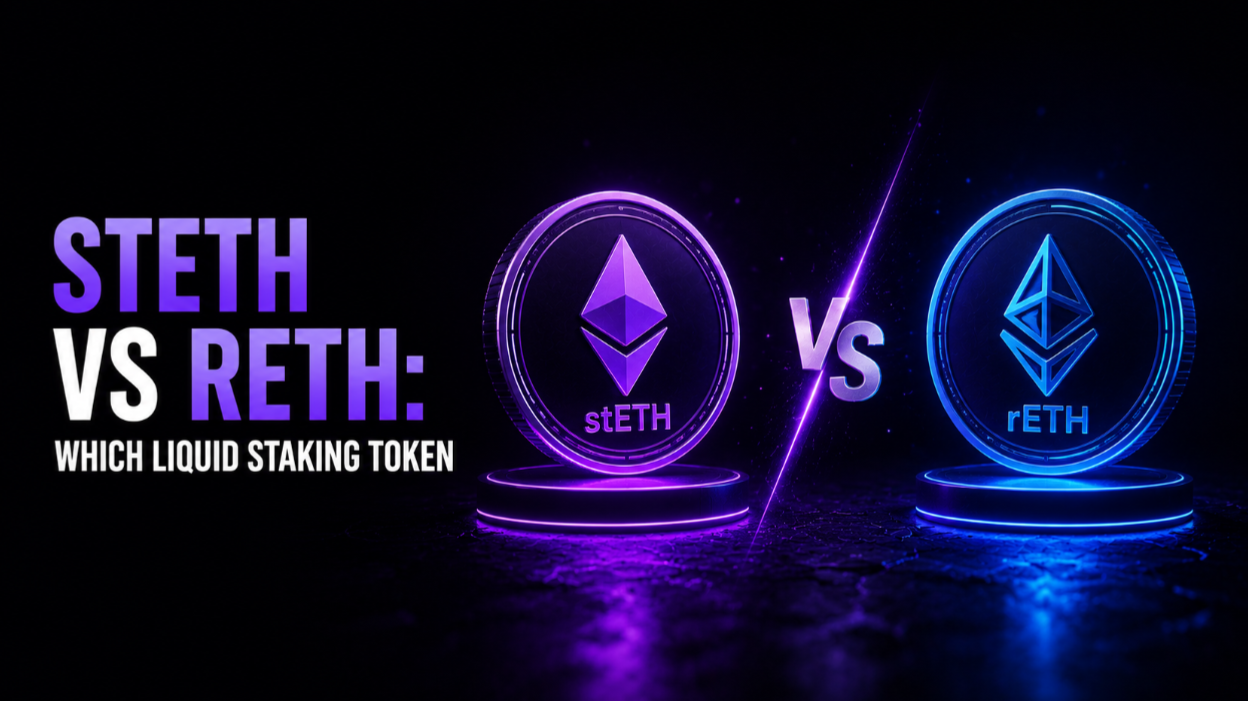
stETH vs rETH: which liquid staking token
One has the better market. The other has the better protection. Neither has both, and that is the trade this category never states.
- Published
- Nov 16, 2026
- Reading time
- 8 min
- Fact-checked by
 ✓ Priya Nair
In this article
7 partsThese are the two serious Ethereum liquid staking tokens, and they are good at opposite things. Choosing between them means deciding which failure you would rather face.
Who absorbs a slashing penalty
Rocket Pool wins this outright, and the mechanism is worth understanding. Node operators post their own ETH bond plus RPL collateral, and that capital is slashed before depositor funds are touched.
It is funded in advance and applies automatically — a real, non-discretionary shield. Compare that with a protocol fund whose size is undisclosed and whose deployment is a governance vote taken after the event, when the incentive to vote for a bailout is at its weakest.
Who has a market
Lido wins this, though the absolute numbers are poor for both. stETH has roughly $17.2bn outstanding against about $113m of on-chain depth — 0.66% — which is thin, and rETH is thinner still relative to its size.
The specific problem with rETH is worse than the ratio suggests: its liquidity is largely paired against other staking tokens rather than against ETH. The biggest rETH pool is against another illiquid liquid staking token. That is not liquidity — it is a chain of illiquid things holding each other up, and it fails at exactly the moment you need it.
Fees and disclosure
Lido charges 10% of yield, and it is the counter-example to our own thesis about hidden fees in DeFi: the advertised APR is already net, the formula is in the documentation, and the public API returns the same number as the front end. That is genuinely good practice and we are not going to manufacture a gap that is not there.
Rocket Pool's economics are structured differently because node operators are independent participants rather than a permissioned set, which is also why it is the more decentralised of the two — a real consideration for anyone who thinks the concentration of Ethereum staking is a systemic issue.
The honest framing
The token with the best structural protection against slashing is not the token with the best market to sell into. That is the standing trade-off in this category, and it does not resolve.
Which matters more depends on which event you consider likely. Slashing at scale is rare, and a depth crisis has happened repeatedly — stETH in June 2022, ezETH in April 2024, wBETH in October 2025. On base rates, depth is the risk that has actually cost people money.
How to choose
- If you might need to exit at size or borrow against the position: stETH, on depth, while accepting that 0.66% is thin in absolute terms.
- If you are holding through cycles and value structural protection and decentralisation: rETH, while understanding its market is paired against other illiquid tokens.
- If exit liquidity is the deciding factor and you will pay for it: Origin Ether charges 20% of yield and roughly 30% of it is genuinely sellable, against 4% for the next best.
- If none of this is appealing: solo staking has no token, no fee and no depth problem — at the cost of 32 ETH and operational responsibility.
The token with the best protection against slashing is not the token with the best market to sell into. That does not resolve.
The short version
rETH protects depositors better — node operator capital is slashed first, funded in advance and automatic. stETH is easier to sell, honestly disclosed and larger. Because depth failures have happened repeatedly and slashing at scale has not, stETH is the more practical choice for most, with rETH the better answer for a long hold you will never need to exit quickly.
Frequently asked questions
4 questionsIs rETH safer than stETH?
Against slashing, yes. Rocket Pool node operators post their own ETH bond and RPL collateral, which is slashed before depositor funds — funded in advance and applied automatically. Against a liquidity crisis, no: rETH is thinner relative to its size and its largest pool is paired against another illiquid staking token.
Which liquid staking token has the most liquidity?
stETH in absolute terms, though the ratio is poor: roughly $17.2bn outstanding against about $113m of on-chain depth, or 0.66%. Origin Ether has by far the best ratio, with around 30% genuinely sellable against 4% for the next best, and charges 20% of yield for it.
What fee does Lido charge?
10% of staking yield. Its advertised APR is already net of that fee, the formula is documented, and its public API returns the same number the front end shows — unusually clear disclosure compared with custodial staking, where Coinbase's implied take is around 29% and published nowhere.
Should I use stETH or rETH?
stETH if you might need to exit at size or borrow against the position, since depth failures are the risk that has repeatedly cost people money. rETH for a long hold where the funded slashing shield and greater decentralisation matter more than the ability to sell quickly.
About the author
Theo Walsh is a U.S.-based Senior Editor specializing in digital asset markets and crypto infrastructure, with a focus on the evolving relationship between blockchain technology, financial markets, and institutional adoption.
How this was reported
ChainWatch Daily is independent and reader-funded. Stories are written by named journalists and checked against primary sources before publishing. We disclose holdings, correct errors in the open, and never accept payment for coverage. This article is information, not financial advice.
More like this
Is liquid staking actually liquid?
The largest staking token in the world has $17.2bn outstanding and about $113m of on-chain depth. Backing was never the question.
 Ethan Brooks·2d ago·9 min
Staking on an exchange: what it costs you
Coinbase pays retail 1.75% of a 2.473% network rate. The 29% it keeps is published nowhere.
Ethan Brooks·4d ago·8 min
What Ethereum staking really pays
2.473% gross — a number nobody advertises, because every product on sale is a subtraction from it.
 Theo Walsh·6d ago·8 min