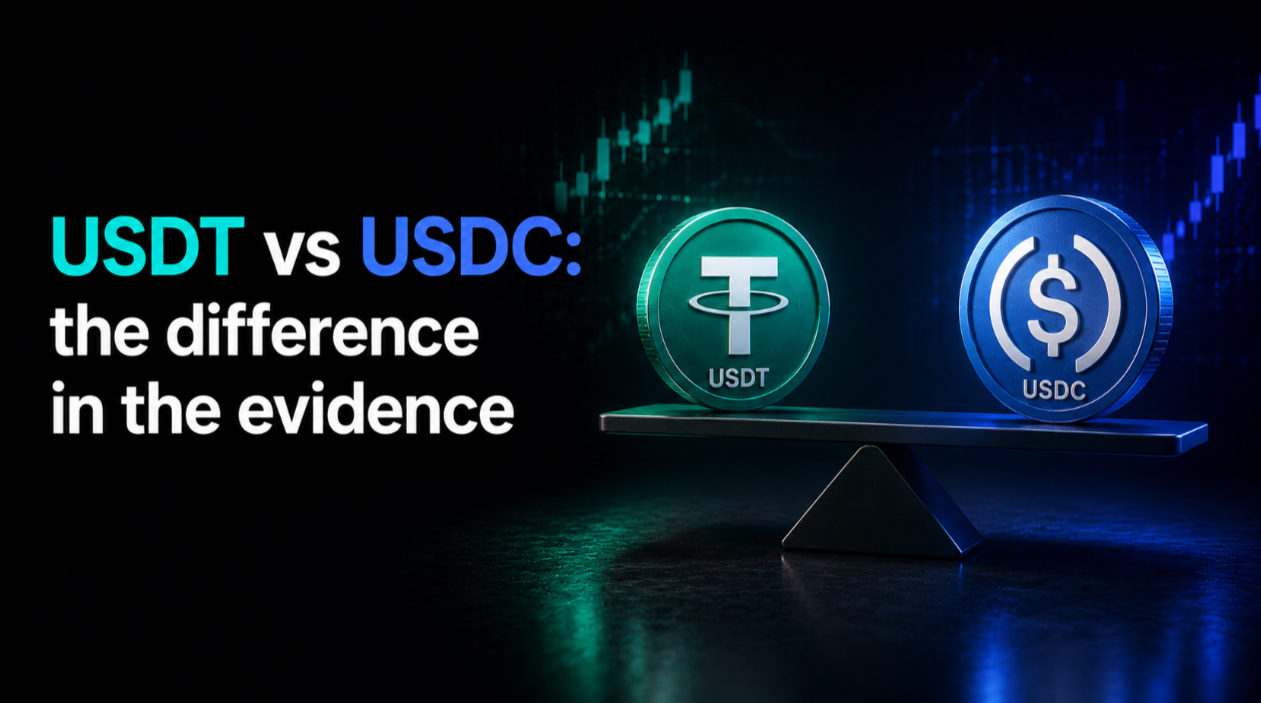
USDT vs USDC: the difference in the evidence
A quarterly attestation and an audited public company are not the same instrument. Neither is the token that broke its peg the one you would guess.
- Published
- Nov 2, 2026
- Reading time
- 8 min
- Fact-checked by
 ✓ Theo Walsh
In this article
7 partsThese are the two dollars of crypto, and the comparison is genuinely mixed: the one with far better evidence is the one that has broken its peg, and the one with weaker documentation is the one that has not.
The evidence
USDC: issued by Circle, a US-listed public company. Audited financial statements filed with a securities regulator, monthly reserve attestations by a major accounting firm, reserves in cash and short-dated Treasuries at regulated institutions, MiCA-licensed in Europe. $73.9bn across 154 chains.
USDT: quarterly attestations rather than a full audit — point-in-time reports, a materially weaker instrument. Reserves include cash and Treasury bills alongside secured loans, bitcoin, gold and other investments. $183.3bn across 130 chains, roughly two and a half times USDC.
The composition difference matters more than the headline. Short-dated government paper is liquid in a crisis. Secured loans, bitcoin and gold behave very differently at exactly the moment redemption pressure arrives.
The peg record says the opposite
USDC traded down to about $0.87 in March 2023 when $3.3bn of Circle's reserves were trapped at Silicon Valley Bank over a weekend. It recovered when the US government guaranteed SVB deposits — full backing did not prevent the break, and a government decision resolved it.
USDT has never broken the same way, through repeated crises and years of predictions that it would. That is a real record, not an accident, and it deserves the same weight as the documentation running the other direction.
Depth and habit
USDT is the money of this industry and nothing else is close. It is the quote currency for almost every order book in crypto, which means using anything else adds a conversion at both ends. On the practical question of moving a large amount at par, at any hour, on almost any chain, USDT wins outright.
USDC's depth is concentrated in regulated venues and DeFi on major chains, which is exactly where a US or EU user is likely to be operating anyway.
What is identical
- Both can freeze your balance, and both have. See can a stablecoin issuer freeze your money.
- Neither pays you the interest on the reserves, which on tens of billions of dollars is a substantial sum going somewhere other than the holder.
- Both are claims on a company. Neither is a bearer asset, and neither behaves like one in a crisis.
How to choose
If you are trading on offshore venues, USDT — it is what the books quote in, and converting to hold something else costs you at both ends.
If you are in the US or EU, on regulated venues or in DeFi on major chains, USDC — comparable utility with materially better evidence, and MiCA licensing matters in Europe.
If the position is large or long-held, both, split — and consider whether it should be a stablecoin at all rather than an instrument that pays you the interest.
Better evidence and better price behaviour are not the same claim. Here, they point at different tokens.
The short version
USDC has the stronger evidence — an audited, listed issuer holding cash and short-dated Treasuries — and it is the one that broke, briefly, in March 2023. USDT has weaker documentation, a broader reserve mix, and a better peg record plus unmatched depth. Both can be frozen and neither pays you. Split across both, and keep the balance a working one.
Frequently asked questions
4 questionsIs USDC safer than USDT?
Its evidence is stronger: Circle is a US-listed public company filing audited financial statements, with monthly attestations over cash and short-dated Treasuries, while Tether publishes quarterly attestations over a mix including secured loans, bitcoin and gold. But USDT has never broken its peg the way USDC did in March 2023.
Why did USDC depeg in 2023?
$3.3bn of Circle's reserves were trapped at Silicon Valley Bank over a weekend, and USDC traded down to about $0.87. It recovered when the US government guaranteed SVB deposits. The reserves were fully backed throughout — the break was about access to them, not their existence.
Which stablecoin has more liquidity, USDT or USDC?
USDT, by a wide margin: $183.3bn outstanding across 130 chains against USDC's $73.9bn across 154 chains, and it is the quote currency for almost every order book in crypto. USDC's depth is concentrated on regulated venues and major-chain DeFi.
Should I hold USDT or USDC?
USDT if you trade on offshore venues, since the books quote in it and converting costs you at both ends. USDC if you are in the US or EU on regulated venues or major-chain DeFi. For a large or long-held position, split across both — every failure in this category has been issuer-specific.
About the author
Ethan Brooks is a U.S.-based Senior Crypto Analyst at ChainWatch with nearly a decade of experience analyzing digital asset markets, blockchain data, and institutional trading activity.
How this was reported
ChainWatch Daily is independent and reader-funded. Stories are written by named journalists and checked against primary sources before publishing. We disclose holdings, correct errors in the open, and never accept payment for coverage. This article is information, not financial advice.
More like this

Can a stablecoin issuer freeze your money?
Almost all of them can. The largest has done it billions of dollars at a time, and there is a public dashboard tracking it.
 Priya Nair·2d ago·7 min
Which stablecoin is safest to hold?
The comparisons rank on market cap and peg stability, and skip the two facts that decide the outcome: who can freeze your balance, and what kind of document the reserve report really is.
 Ethan Brooks·4d ago·10 min

What happened at every exchange that lost customer money
The incidents are the least interesting part. The question that separates these venues is what happened in the seventy-two hours afterwards.
Priya Nair·6d ago·9 min