What is Uniswap (UNI)?
RANK #23The exchange that replaced order books with a formula, and the governance token that spent six years entitled to nothing. That ended in December 2025: UNIfication turned on the fee switch, burned 100 million UNI from the treasury in one go — roughly $596m — and started routing protocol fees into ongoing burns. By July 2026 daily protocol revenue had gone from $114,000 to $325,000, with Ark Invest putting annualised burns near $90m.
Uniswap market stats
Uniswap at a glance
- What it is
- Automated market maker — liquidity pools and a pricing formula instead of an order book
- One-time burn
- 100,000,000 UNI from the treasury, roughly $596m
- v2 split
- LP share cut to 0.25%; the remaining 0.05% goes to protocol buyback and burn
- v3 split
- The protocol captures 16.7% of fees in high-volatility pools
- Daily revenue
- $114,000 to $325,000 after Proposal 100 extended the switch to v4 across seven networks in July 2026
Categories: Decentralized Exchange (DEX) · Exchange-based Tokens · Decentralized Finance (DeFi) · Yield Farming · Automated Market Maker (AMM) · BNB Chain Ecosystem
How Uniswap works
Uniswap replaced the order book. Instead of matching buyers to sellers, it holds two assets in a pool and prices them by a formula: multiply the reserves together and keep that product constant. Buy one asset and you shrink its side of the pool, so the price moves. There is no counterparty and no market maker quoting — just liquidity providers who deposit both assets and earn a share of every trade.
That is the whole idea and it turned out to be enough to run one of the largest exchanges in crypto with no staff on the trading desk at all. Every DEX that followed is a variation on it.
The versions, which people search for by name
- v1 (2018): the original proof that the formula worked. ETH on one side of every pool, nothing else.
- v2 (2020): any token against any token, plus price oracles. The version that made DeFi composable.
- v3 (2021): concentrated liquidity — providers choose a price range instead of spreading capital across every price from zero to infinity. Vastly more capital-efficient and much harder to do well, which is when liquidity provision stopped being passive.
- v4 (2024): hooks. Code that runs at defined points in a pool's lifecycle, so a pool can have custom logic — dynamic fees, limit orders, its own rules — without forking the protocol.
Hooks are the interesting part of v4 and the least understood. Aggregator hooks can source liquidity from other on-chain protocols and add a programmatic UNI burn on top, which turns Uniswap itself into an aggregator anyone can plug into rather than a venue competing with them.
What UNIfication actually did
For six years Uniswap charged traders a fee and gave all of it to liquidity providers. UNI holders governed a protocol that generated enormous volume and no revenue for the protocol itself. The "fee switch" — a parameter that would divert a slice to the protocol — was debated for years and never flipped, partly over fear of driving liquidity elsewhere and partly over what turning a governance token into a revenue-sharing one would mean legally.
In December 2025 governance approved UNIfication and flipped it. On v2, the liquidity provider share fell to 0.25% and the remaining 0.05% now funds buybacks and burns. On higher-fee v3 pools the protocol takes 16.7%. A one-time burn destroyed 100 million UNI from the treasury. In July 2026 Proposal 100 extended the switch to v4 pools across seven networks, taking daily protocol revenue from $114,000 to $325,000.
What UNI is used for
- Governance over the protocol, the treasury and — now — the fee parameters that determine revenue.
- The burn: protocol fees buy and destroy UNI, which is a claim on revenue in economic effect if not in legal form.
- Delegation, for holders who want their vote used without voting themselves.
The honest framing of the change: UNI is still not a security and holders still have no enforceable claim on anything. What they have is a supply that shrinks in proportion to how much the protocol earns. Ark Invest's estimate of roughly $90m in annualised burns is the figure to test against reality over the next year, and the daily revenue number is public, so it can be tested rather than argued about.
The trade-off nobody should skip
Every basis point routed to the protocol is a basis point not paid to liquidity providers. Cutting v2's LP share to 0.25% makes providing liquidity on Uniswap slightly less attractive than it was, in a market where liquidity is mobile and competitors have not made the same choice. The bet is that Uniswap's depth and integrations make it stickier than the margin. It is a reasonable bet and it is a bet.
UNI tokenomics and supply
1 billion UNI was created in September 2020 with a four-year distribution to the community, team, investors and advisors, followed by a perpetual 2% annual inflation that governance has never activated in practice.
The treasury held a very large share, and UNIfication burned 100 million of it outright — roughly $596m destroyed in a single governance action. That is one of the largest deliberate token burns ever executed, and it materially changed the supply picture rather than gesturing at it.
Ongoing, protocol fees fund continuous buyback-and-burn. So UNI's supply now moves with Uniswap's trading volume: busy markets shrink it, quiet ones do not. The asset went from a pure governance claim to something whose supply tracks the business, without ever becoming a dividend.
UNI staking and yield
UNI cannot be staked. There is no validator set and no protocol yield — Uniswap runs on Ethereum and its rollups, secured by them.
Delegating voting power is the participation mechanism and it pays nothing. The way people actually earn on Uniswap is by providing liquidity, which is a different activity with a specific risk: impermanent loss, where a pool's rebalancing leaves you worse off than simply holding the two assets. On v3 and v4, with concentrated ranges, that risk is sharper and requires active management. Anyone describing liquidity provision as staking is describing something else.
Uniswap risks
The fee switch has two edges
Taking a cut from liquidity providers in a market where liquidity can move overnight is the central risk of the new model. If depth migrates to venues that pay providers more, volume follows, and the revenue funding the burn shrinks with it. The burn is a function of volume, and volume is a function of depth.
Regulatory position of a revenue-linked token
The fee switch sat unused for years partly because routing protocol revenue to a token invites the question of what that token is. A burn is not a dividend, and the distinction is deliberate and legally meaningful. It is also a distinction regulators have not comprehensively tested, and Uniswap Labs has been under scrutiny before.
Competition on price and on flow
Aggregators route around venues on price, so Uniswap competes trade by trade rather than holding users by habit. CoW Swap, 1inch and intent-based routing sit between users and pools, and Curve and Balancer hold specific niches. Uniswap's advantages are depth and integration, both of which erode if the economics tilt against providers.
Governance concentration
Large delegates decide Uniswap's votes, and those votes now allocate real revenue. Turnout is low relative to supply. The upgrade that made UNI economically interesting also made its governance worth capturing.
Smart contract risk, mitigated but not zero
The core contracts have held billions for years without a protocol-level failure, which is about as strong a record as exists in DeFi. v4 hooks change that calculus: arbitrary code running inside a pool's lifecycle means a pool is only as safe as its hook, and users will not always know what they are interacting with.
Uniswap: key events
- Nov 2, 2018 — Uniswap v1 launches, pairing every token against ETH.
- May 18, 2020 — v2 allows any token pair and makes Uniswap a composable primitive.
- Sep 17, 2020 — The UNI airdrop creates the governance token and the DAO.
- May 5, 2021 — v3 introduces concentrated liquidity.
- Jun 1, 2024 — v4 introduces hooks, letting pools carry custom logic.
- Dec 1, 2025 — UNIfication activates the fee switch and burns 100m UNI from the treasury.
- Jul 1, 2026 — Proposal 100 extends the fee switch to v4 across seven networks; daily revenue rises to $325,000.
Uniswap FAQ
What is the Uniswap fee switch?
+
A protocol parameter that diverts part of each trade's fee from liquidity providers to the protocol. Debated for years and finally activated by the UNIfication proposal in December 2025. On v2 the LP share fell to 0.25% and the remaining 0.05% funds UNI buybacks and burns; on high-volatility v3 pools the protocol takes 16.7%.
Does UNI have value now?
+
Economically, yes — though not as a dividend. Protocol fees buy and burn UNI, so the supply shrinks in proportion to what Uniswap earns. A one-time burn destroyed 100 million UNI from the treasury, roughly $596m, and Ark Invest estimates ongoing annualised burns near $90m. Holders still have no enforceable claim on revenue, which is a deliberate legal distinction.
What is the difference between Uniswap v2, v3 and v4?
+
v2 (2020) let any token pair trade and made DeFi composable. v3 (2021) added concentrated liquidity, so providers pick a price range — far more capital-efficient and much more active work. v4 (2024) added hooks: custom code running at points in a pool's lifecycle, enabling dynamic fees, limit orders and pool-specific rules without forking the protocol.
What are Uniswap v4 hooks?
+
Contracts that execute at defined moments in a pool's life — before or after a swap, when liquidity is added, and so on. They let a pool have its own logic. Aggregator hooks go further, sourcing liquidity from other on-chain protocols and adding a programmatic UNI burn, which makes Uniswap an aggregator others integrate rather than only a venue.
Can you stake UNI?
+
No. Uniswap runs on Ethereum and its rollups, so there is no validator set and no protocol yield. You can delegate voting power, which pays nothing. Providing liquidity is a different activity entirely, with impermanent loss as its specific risk.
Is Uniswap safe?
+
The core contracts have held billions for years with no protocol-level failure, which is close to the strongest record in DeFi. The newer risk is v4 hooks: because arbitrary code can run inside a pool's lifecycle, a pool is only as safe as its hook, and that is not always visible to the user.
How much revenue does Uniswap make?
+
Daily protocol revenue rose from $114,000 to $325,000 after Proposal 100 extended the fee switch to v4 pools across seven networks in July 2026. Ark Invest estimates annualised burns of roughly $90m. These are public figures, so the estimate can be checked against outcomes.
Sources
This page is information, not financial advice. Prices come from CoinGecko; the text is written and checked by our desk. See our editorial policy.
Uniswap news & analysis

The EU’s crypto rulebook enters its next compliance phase
Europe's unified crypto framework is shifting from paper to practice, forcing exchanges, custodians and stablecoin issuers to prove they can operate under bank-style oversight or leave the market.
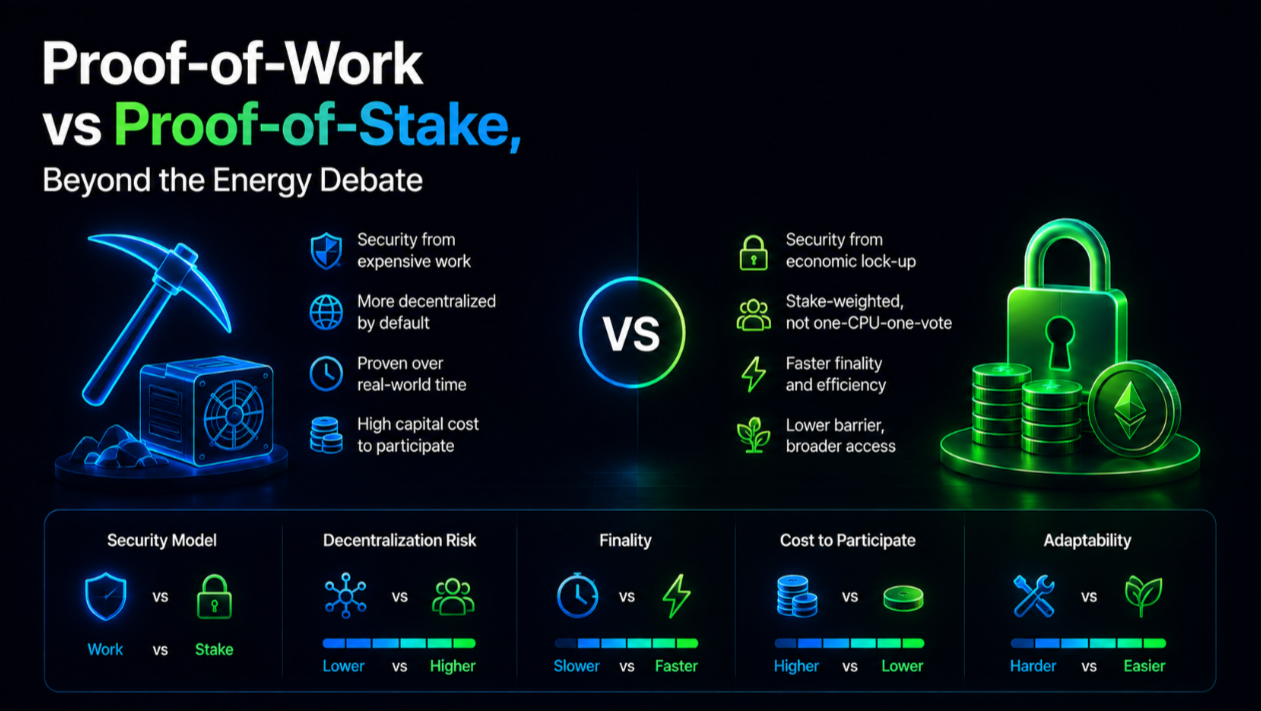
Proof-of-work versus proof-of-stake, beyond the energy debate
The real gap between proof-of-work and proof-of-stake isn't watts. It's where security comes from, how misbehavior is punished, who gets to participate, and how each holds up under censorship.