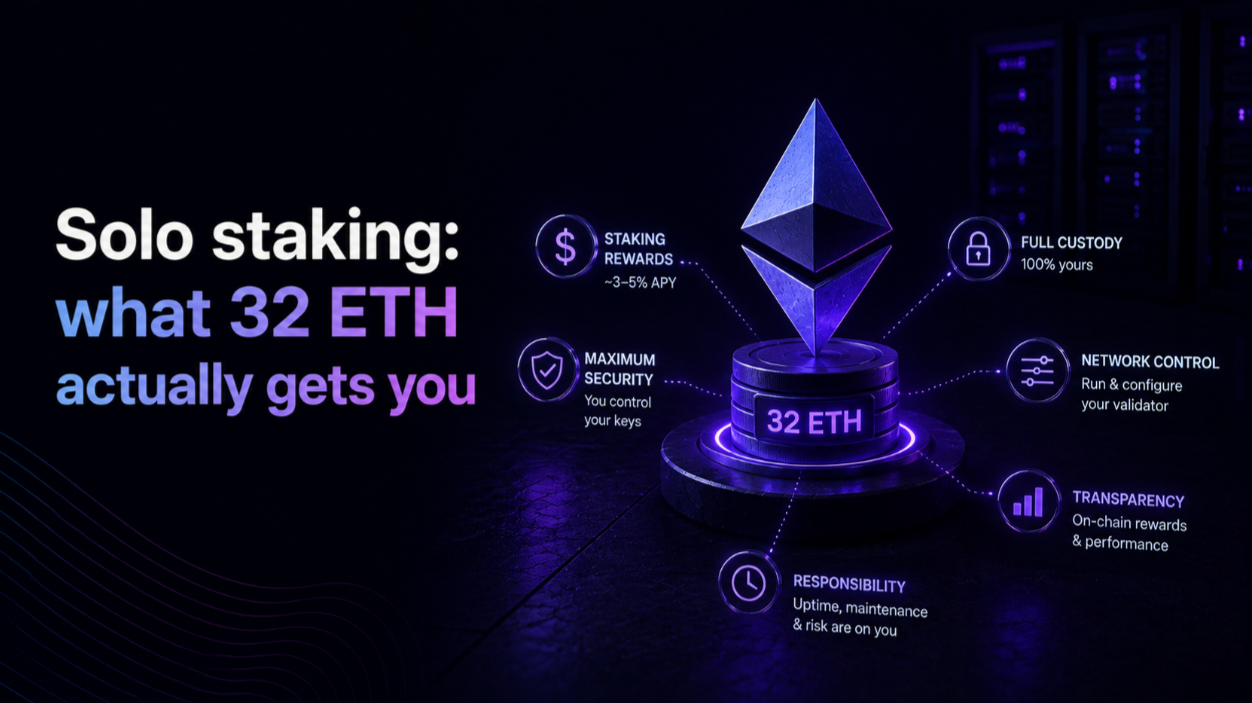
Solo staking: what 32 ETH actually gets you
The full rate, no counterparty, no token to sell — and every operational risk landing on you rather than on a company.
- Published
- Nov 26, 2026
- Reading time
- 8 min
- Fact-checked by
 ✓ Ethan Brooks

In this article
7 partsSolo staking pays about 2.473% — the full rate Ethereum actually pays — and takes no commission at all. Every other product in this market is that number minus somebody's cut, and the cuts run from 8% at the best liquid staking protocols to roughly 29% at the largest custodian.
That makes it the reference point for the whole category, and the honest question is what the difference is worth against what it asks of you.
What you get
- The entire network reward, with nobody taking a share.
- No counterparty. There is no company holding your keys, no protocol contract to be drained, and no token whose price can detach from what it represents.
- No depth problem. You never need anyone to buy anything from you — the position exits through the network's own queue, not through a market.
- Direct participation in consensus, which is the decentralisation argument and is real, whatever weight you give it.
What it asks
32 ETH, which is the barrier most people stop at, and then a machine that stays online. The requirement is not high-performance hardware; it is reliability. Downtime does not lose your stake, but it does mean missed rewards, and enough of it becomes a slow leak.
Slashing is the serious risk, and it is worth being precise about it: the protocol slashes for provable misbehaviour — signing conflicting messages — not for being offline. The commonest cause is running the same validator keys in two places at once, which is exactly what happens when someone restores a backup while the original is still running.
That is a procedural risk, not a technical one, and it is why the operational discipline matters more than the machine.
The exit
Voluntary exit goes through the network's queue, which takes days and varies with how many others are leaving. There is no market to sell into and no counterparty to ask. That is a limitation and it is also the reason none of the depth failures that have hit liquid staking tokens can happen to you.
Is the difference worth it?
On 32 ETH, the gap between the full 2.473% and Lido's 2.226% is about 0.25 percentage points — a small amount in absolute terms. Against a custodian taking 29%, the gap is closer to 0.7 points, which is more meaningful.
But the yield is not the strongest argument. The strongest argument is that solo staking is the only arrangement in this category with no counterparty and no exit-liquidity risk — and those are the two things that have actually cost people money, while the fee difference has merely annoyed them.
Who should not do it
Anyone who will not maintain it. A validator is an ongoing obligation: client updates, monitoring, and a plan for what happens when you are away or unwell. An unmaintained validator earns less than a custodial account and carries risks a custodial account does not.
If that describes you, a liquid staking token at a 10% fee is the honest alternative, and an exchange at 29% is the expensive one.
Nobody beats not paying anyone. The question is whether you will keep the machine running.
The short version
Solo staking pays the full 2.473% with no commission, no counterparty and no dependence on anyone buying a token from you. It costs 32 ETH, a reliable machine and genuine operational discipline — with the main slashing risk being a procedural one, running the same keys twice. If you will maintain it, it is the best arrangement in this category by a wide margin.
Frequently asked questions
4 questionsHow much does solo staking Ethereum pay?
About 2.473%, the full gross rate the network pays, with no commission to anyone. Liquid staking protocols return roughly 2.226% after a 10% fee, and the largest custodian pays retail about 1.75% — an implied take of around 29%.
Do you need 32 ETH to stake?
To run your own validator, yes. Below that, the alternatives are liquid staking tokens, which charge around 10% of yield and add an exit-liquidity risk, or custodial staking at an exchange, which has no minimum and takes the largest share.
What is the risk of solo staking?
Slashing for provable misbehaviour — most commonly running the same validator keys in two places at once, which happens when someone restores a backup while the original is still running. Downtime does not lose your stake but forfeits rewards. Both are procedural risks rather than technical ones.
How long does it take to exit solo staking?
Days, through the network's own exit queue, and the wait varies with how many validators are leaving at the time. There is no market to sell into — which is a limitation and also the reason none of the depth failures that have hit liquid staking tokens can affect a solo staker.
About the author
Theo Walsh is a U.S.-based Senior Editor specializing in digital asset markets and crypto infrastructure, with a focus on the evolving relationship between blockchain technology, financial markets, and institutional adoption.
How this was reported
ChainWatch Daily is independent and reader-funded. Stories are written by named journalists and checked against primary sources before publishing. We disclose holdings, correct errors in the open, and never accept payment for coverage. This article is information, not financial advice.
More like this
How crypto staking actually works
The network pays one rate. Everything you can buy is that rate minus somebody's cut, and the cuts run from 8% to 29% — mostly undisclosed.
Ethan Brooks·Nov 8, 2026·9 min
Where DeFi yield actually comes from
Four sources. Three of them are somebody else paying, and one is your own capital coming back to you dressed as a return.
Ethan Brooks·6d ago·9 min
Every question to ask before depositing on a new exchange
You have chosen the venue. This is the half-hour of setup that decides whether an account compromise costs you everything or nothing.
Ethan Brooks·Oct 25, 2026·8 min