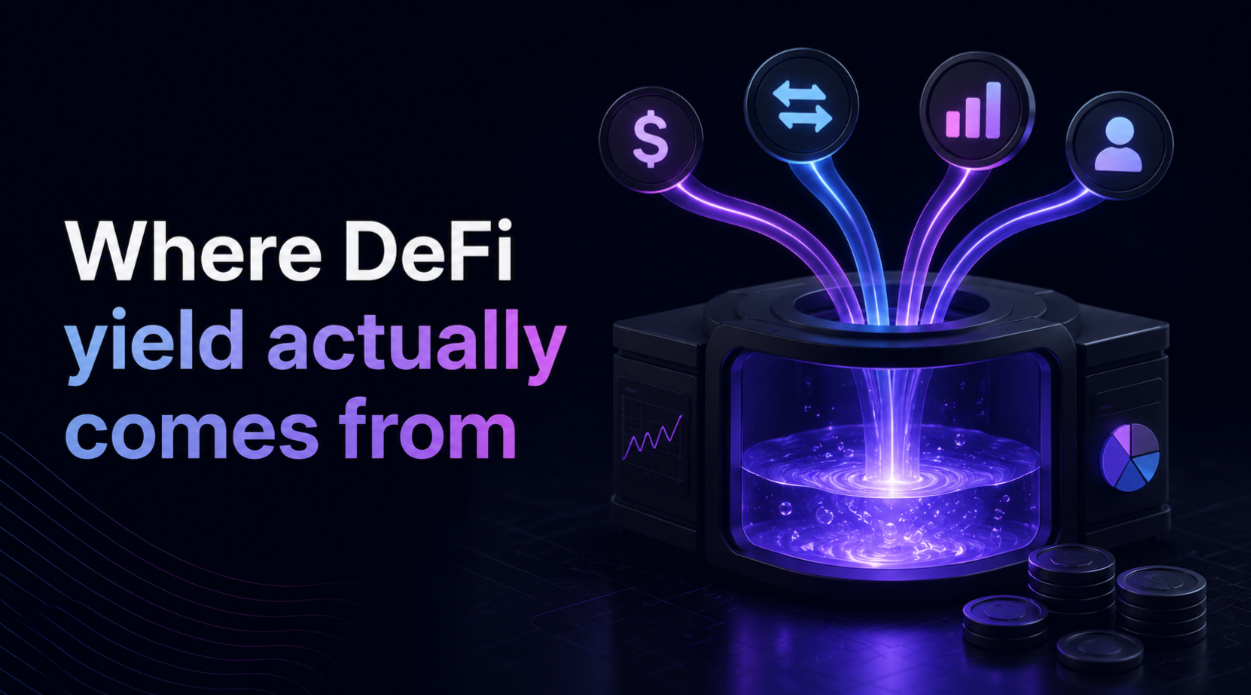
Where DeFi yield actually comes from
Four sources. Three of them are somebody else paying, and one is your own capital coming back to you dressed as a return.
- Published
- Nov 20, 2026
- Reading time
- 9 min
- Fact-checked by
 ✓ Theo Walsh
In this article
9 partsEvery yield in DeFi comes from one of four places. Working out which one takes about a minute and tells you almost everything about whether the rate is sustainable.
Interest paid by borrowers
The most durable source. Someone borrows your deposit and pays for it, which means the yield is limited by real demand to borrow, and it persists as long as that demand does.
This is testable, and the test is revealing. We computed what each lending market actually earns per dollar deposited — thirty days of protocol fees, annualised, over total value locked. JustLend has $3.72bn deposited and generates 0.56% a year of gross interest on it. Euler has $366m and generates 6.37%.
Capital in this category is not priced by how much of it there is. It is priced by whether anyone is really borrowing — which is why total value locked is a misleading headline number.
Trading fees
Liquidity providers on a decentralised exchange earn a share of the fees traders pay. Also durable, also limited by real activity — and carrying a cost that the advertised yield never nets off: impermanent loss, which is what providing liquidity costs you when the price moves.
A pool advertising 20% while its assets diverge can leave you worse off than holding. The fee yield is real; it is a gross number.
Network rewards
Staking yield, paid by the protocol out of issuance and transaction fees. Durable, predictable, and low: Ethereum pays about 2.473% gross, which is the ceiling every staking product subtracts from.
Token emissions
The protocol pays you in its own newly issued token. This is the source behind almost every headline rate that looks too good, and it is not a return on your capital — it is a transfer from future token holders to you, for as long as the programme runs.
Emissions are not automatically bad. They are a customer acquisition cost, spent deliberately, and taking them is a legitimate trade. But the rate is a function of a decision that can be changed at any time, and the token you are paid in usually falls as it is distributed.
The fifth source, which is not a source
Your own capital. Some products pay a yield that is partly a return of your deposit, or is denominated in a token whose price is falling faster than the yield accrues. Priced honestly, that is a loss with a positive number attached — the same arithmetic that sinks most crypto card rewards.
How to identify the source in one minute
- Is the yield paid in the asset you deposited, or in a governance token? The second is emissions.
- What is the fee income of the protocol against its deposits? If the yield exceeds it, the difference comes from somewhere other than users paying for a service.
- Who is on the other side? Every durable yield has a payer — a borrower, a trader, a network. If you cannot name them, it is emissions or worse.
- What happens if activity halves? Fee-based and interest-based yields fall proportionally. Emissions carry on regardless, which is precisely why they are not information about demand.
The comparison to make
For a stablecoin yield, compare against a Treasury bill and be honest about the answer. The spread over that rate is what you are being paid for smart contract risk, liquidation machinery, counterparty exposure and the possibility that the yield source disappears. Sometimes that spread is generous. Frequently it is not — our lending rating prices each one.
Every durable yield has a payer. If you cannot name them, you are the payer.
The short version
Borrower interest and trading fees are durable and limited by real demand; network rewards are durable and low; token emissions are a marketing budget that stops. Identify which one you are being paid from before depositing, and measure any stablecoin yield against a Treasury bill to see what the spread is really compensating.
Frequently asked questions
4 questionsWhere does DeFi yield come from?
Four sources: interest paid by borrowers, a share of trading fees, network staking rewards, and newly issued protocol tokens. The first three are limited by real demand and are durable; the fourth is a marketing budget that can stop at any time and usually falls in value as it is distributed.
Is high DeFi yield sustainable?
Only if it comes from borrowers or traders actually paying for something. A quick test: compare the protocol's fee income against its deposits. JustLend holds $3.72bn and generates 0.56% a year of gross interest; Euler holds $366m and generates 6.37%. Yield above fee income comes from emissions.
What are token emissions in DeFi?
Yield paid in a protocol's own newly issued token rather than in the asset you deposited. It is a transfer from future token holders to current depositors — a customer acquisition cost rather than a return on capital — and the rate is a decision that can be changed at any time.
How do I know if a DeFi yield is real?
Name the payer. A durable yield always has one: a borrower, a trader, or the network itself. Check whether you are paid in the asset you deposited or in a governance token, and ask what happens to the rate if activity halves — real yields fall with it, emissions do not.
About the author
Ethan Brooks is a U.S.-based Senior Crypto Analyst at ChainWatch with nearly a decade of experience analyzing digital asset markets, blockchain data, and institutional trading activity.
How this was reported
ChainWatch Daily is independent and reader-funded. Stories are written by named journalists and checked against primary sources before publishing. We disclose holdings, correct errors in the open, and never accept payment for coverage. This article is information, not financial advice.
More like this
How crypto staking actually works
The network pays one rate. Everything you can buy is that rate minus somebody's cut, and the cuts run from 8% to 29% — mostly undisclosed.
 Ethan Brooks·Nov 8, 2026·9 min
Every question to ask before depositing on a new exchange
You have chosen the venue. This is the half-hour of setup that decides whether an account compromise costs you everything or nothing.
Ethan Brooks·Oct 25, 2026·8 min
Do you need a multisig wallet?
The threshold is the point where one recovery phrase becomes the weakest part of your setup — and where you will genuinely maintain three backups instead of one.
Theo Walsh·Oct 23, 2026·8 min