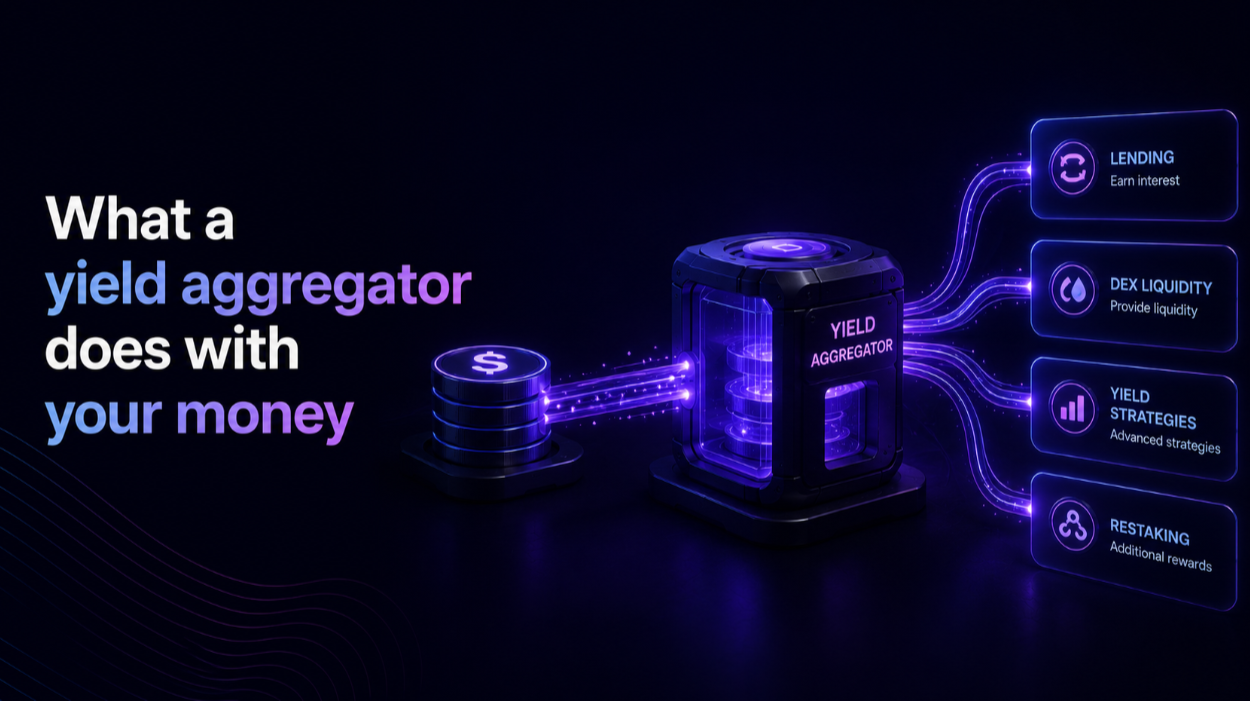
What a yield aggregator does with your money
You are not buying a rate. You are buying discretion: somebody else moves your deposit, changes their mind without asking, and keeps a share.
- Published
- Nov 24, 2026
- Reading time
- 8 min
- Fact-checked by
 ✓ Priya Nair
In this article
7 partsA yield aggregator takes your deposit, routes it into other protocols, moves it when the rates change, and keeps a share of the result. Every comparison in this category leads with the APY — which is the number the depositor has the least control over and the protocol has the most control over displaying.
What you are actually buying is discretion. That can be worth paying for. It should be priced as what it is.
What the discretion covers
- Which protocols your money enters. You are inheriting every risk of every venue the strategy touches, not just the aggregator's own.
- When it moves. Rebalancing happens without asking you, and each move is a transaction with its own exposure.
- What the strategy actually is. Some are documented in detail; several are described only in general terms.
- How much is kept. Performance fees, management fees and the gap between gross and displayed yield vary widely.
The case that should order your thinking
Yearn, twice, with opposite outcomes.
February 2021: its DAI vault lost about $11m when an attacker manipulated the Curve pool the strategy depended on. Yearn repaid the victims out of its treasury, minting 9.7m DAI against YFI to do it.
April 2023: a legacy yUSDT contract, misconfigured since 2020 to reference the wrong Fulcrum token, was drained for roughly $10m. There was no comparable make-whole.
Same protocol, same category, opposite outcomes for depositors. Whether you get paid back is a property of the moment — the treasury's size, the loss's cause, who was affected — not of the brand. That is why our yield aggregator rating puts 30% of the score on who holds the keys.
The risk you cannot see from the outside
A strategy's risk is the union of everything it touches, and that set changes without notice. A vault that was conservative last month can be somewhere else this month, and the interface will still show one number.
The February 2021 loss is the clearest illustration: the vault itself was not broken. The pool its strategy depended on was manipulated. Depositors had exposure to a protocol they had not chosen and might not have named.
When it is worth it
If you would otherwise leave capital idle, if the gas cost of managing positions yourself exceeds the fee, or if the strategy does something you genuinely could not — auto-compounding at a frequency that is uneconomic at your size, for instance — the fee buys something real.
It is not worth it when the alternative is depositing directly into one mature lending protocol. That is one contract's risk instead of several, no discretion exercised on your behalf, and no share taken.
What to check before depositing
- Which protocols can this strategy enter? If the answer is open-ended, so is your risk.
- Who can change the strategy, and is there a timelock before changes take effect?
- What is the fee, and is the displayed APY gross or net of it?
- What happened after past losses — and read the aftermath rather than the headline, because that is where the difference between protocols actually shows.
- How does the rate compare with depositing directly? If the difference is small, you are paying for convenience, which is fine as long as you know that is the purchase.
The advertised APY is the number the depositor controls least and the protocol controls most.
The short version
An aggregator sells discretion, not yield. You inherit the risk of every protocol its strategy touches, that set changes without notice, and whether you are made whole after a loss depends on the circumstances rather than the name. Worth paying for genuine automation you could not do yourself; not worth paying when the alternative is one direct deposit into a mature protocol.
Frequently asked questions
4 questionsWhat is a yield aggregator?
A protocol that takes your deposit, routes it into other yield-bearing protocols, moves it as rates change, and keeps a share of the return. What you are buying is discretion — somebody else deciding where your money sits — rather than a specific rate.
Are yield aggregators safe?
Your risk is the union of every protocol the strategy touches, and that set can change without notice. Yearn's February 2021 vault loss came from a manipulated Curve pool the strategy depended on, not from Yearn's own contracts — depositors were exposed to a protocol they had not chosen.
Do yield aggregators reimburse losses?
Sometimes, and it is not predictable from the brand. Yearn repaid victims from its treasury after a roughly $11m loss in February 2021, and there was no comparable make-whole after a roughly $10m drain of a legacy contract in April 2023.
Is it better to use an aggregator or deposit directly?
Direct deposit into one mature lending protocol means one contract's risk, no discretion exercised on your behalf and no share taken. An aggregator earns its fee when it does something you genuinely cannot — such as auto-compounding at a frequency that would be uneconomic at your position size.
About the author
Ethan Brooks is a U.S.-based Senior Crypto Analyst at ChainWatch with nearly a decade of experience analyzing digital asset markets, blockchain data, and institutional trading activity.
How this was reported
ChainWatch Daily is independent and reader-funded. Stories are written by named journalists and checked against primary sources before publishing. We disclose holdings, correct errors in the open, and never accept payment for coverage. This article is information, not financial advice.
More like this
Is your stablecoin yield worth the risk?
Compare it against a Treasury bill first. Then decide what the spread is actually compensating you for.
Priya Nair·2d ago·8 min
Restaking, and the risk nobody quantifies
Several restaked tokens pay less than a plain stake while carrying strictly more risk. That is not a subtle finding.
 Ethan Brooks·6d ago·8 min
stETH vs rETH: which liquid staking token
One has the better market. The other has the better protection. Neither has both, and that is the trade this category never states.
 Theo Walsh·Nov 16, 2026·8 min