Restaking, and the risk nobody quantifies
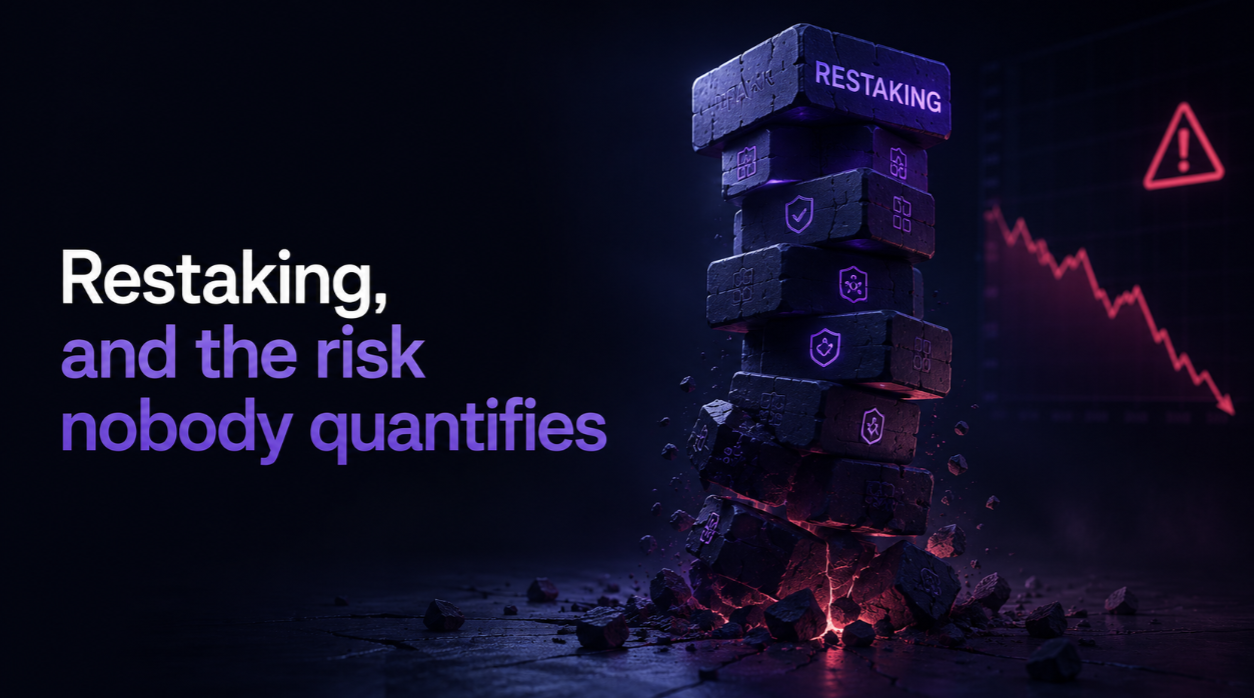
Several restaked tokens pay less than a plain stake while carrying strictly more risk. That is not a subtle finding.
- Published
- Nov 18, 2026
- Reading time
- 8 min
- Fact-checked by
 ✓ Theo Walsh
In this article
7 partsA restaked token is not a staking token with a better yield. It is a staking token plus a second layer of slashing conditions, imposed by services your stake is now securing in addition to Ethereum itself.
That is the correct mental model, and once you hold it, the category's defining number becomes hard to look away from: several of these tokens pay less than simply staking, while carrying strictly more risk.
What you are actually agreeing to
Your staked ETH becomes collateral for additional services — oracles, bridges, data availability layers — each with its own conditions under which your stake can be penalised. The extra yield is payment for accepting those conditions.
Since April 2025 there is a further wrinkle: redistribution lets a service take your slashed stake rather than burn it. Ethereum's own slashing destroys the penalty; redistribution hands it to a counterparty. Those are different things, and the second creates an incentive the first does not.
Why we score it against plain staking
Because that is the alternative it has to beat. Ethereum pays about 2.473% gross for a single, well-understood slashing regime. A restaked token has to pay more than that to justify a second layer of conditions that are newer, more numerous and less examined.
Several do not. That is why our liquid restaking rating measures every token against the plain-staking ceiling rather than against each other — comparing restaked tokens only with one another hides the fact that the whole category may be underpaying.
And then the depth problem, again, worse
Every restaked token is thinner than the staking token it wraps. In April 2024, ezETH wicked 73% on a fully-backed token, because there was no market to sell into.
That is the same failure as the liquid staking depth problem, one layer further out, on tokens with less history and fewer holders. Adding a wrapper never adds liquidity.
The case for the category
It is real, and it should be stated. Restaking lets a large amount of already-staked capital secure new services without requiring fresh capital, which is a genuine efficiency for the services being secured. If the extra yield genuinely compensates the extra slashing risk, it is a fair trade.
The problem is that nobody prices the second layer. There is no established base rate for how often these conditions trigger, no history to reason from, and the yields on offer do not appear to be derived from any such estimate.
The honest answer
For almost everyone: do not use this category at all. That is our conclusion and we would rather state it plainly than dress it as a ranking.
If you do, the questions worth answering first are: what exactly can slash this stake and under what conditions, is the penalty burned or redistributed, how much of the token could you actually sell today, and does the extra yield over plain staking exceed a rate you would accept for an unquantified risk. If any of those has no clear answer, that is the answer.
Several restaked tokens pay less than a plain stake while carrying strictly more risk. Nothing subtle is going on here.
The short version
Restaking adds a second slashing layer — and, since April 2025, one where your penalty can be taken rather than burned — to a staking yield of about 2.473%. Several tokens pay less than that baseline. Every one is thinner than the token it wraps, and one wicked 73% while fully backed. For most people the correct exposure is none.
Frequently asked questions
4 questionsWhat is restaking in crypto?
Using already-staked ETH as collateral to secure additional services — oracles, bridges, data availability layers — each of which adds its own slashing conditions. The extra yield is payment for accepting those conditions on top of Ethereum's own.
Is restaking worth the risk?
Frequently not. Several restaked tokens pay less than a plain stake's approximately 2.473% while carrying strictly more slashing risk, and nobody has established a base rate for how often the second layer triggers. Our conclusion for most readers is to avoid the category entirely.
What is slashing redistribution?
A change from April 2025 that lets a service take your slashed stake rather than burn it. Ethereum's own slashing destroys the penalty; redistribution transfers it to a counterparty, which creates an incentive to trigger penalties that burning does not.
Are liquid restaking tokens liquid?
Less so than the staking tokens they wrap, in every case we measured. In April 2024 ezETH wicked 73% on a fully-backed token because there was no market to sell into. Wrapping an illiquid asset never adds liquidity to it.
About the author
Ethan Brooks is a U.S.-based Senior Crypto Analyst at ChainWatch with nearly a decade of experience analyzing digital asset markets, blockchain data, and institutional trading activity.
How this was reported
ChainWatch Daily is independent and reader-funded. Stories are written by named journalists and checked against primary sources before publishing. We disclose holdings, correct errors in the open, and never accept payment for coverage. This article is information, not financial advice.
More like this
stETH vs rETH: which liquid staking token
One has the better market. The other has the better protection. Neither has both, and that is the trade this category never states.
Theo Walsh·6d ago·8 min
Is liquid staking actually liquid?
The largest staking token in the world has $17.2bn outstanding and about $113m of on-chain depth. Backing was never the question.
 Ethan Brooks·Nov 14, 2026·9 min
Staking on an exchange: what it costs you
Coinbase pays retail 1.75% of a 2.473% network rate. The 29% it keeps is published nowhere.
Ethan Brooks·Nov 12, 2026·8 min