Air-gapped wallets: when the extra step is worth it
A device that never connects to anything removes a whole class of attack, and adds friction to every single transaction. Both halves are real.
Air-gapped wallets: when the extra step is worth it
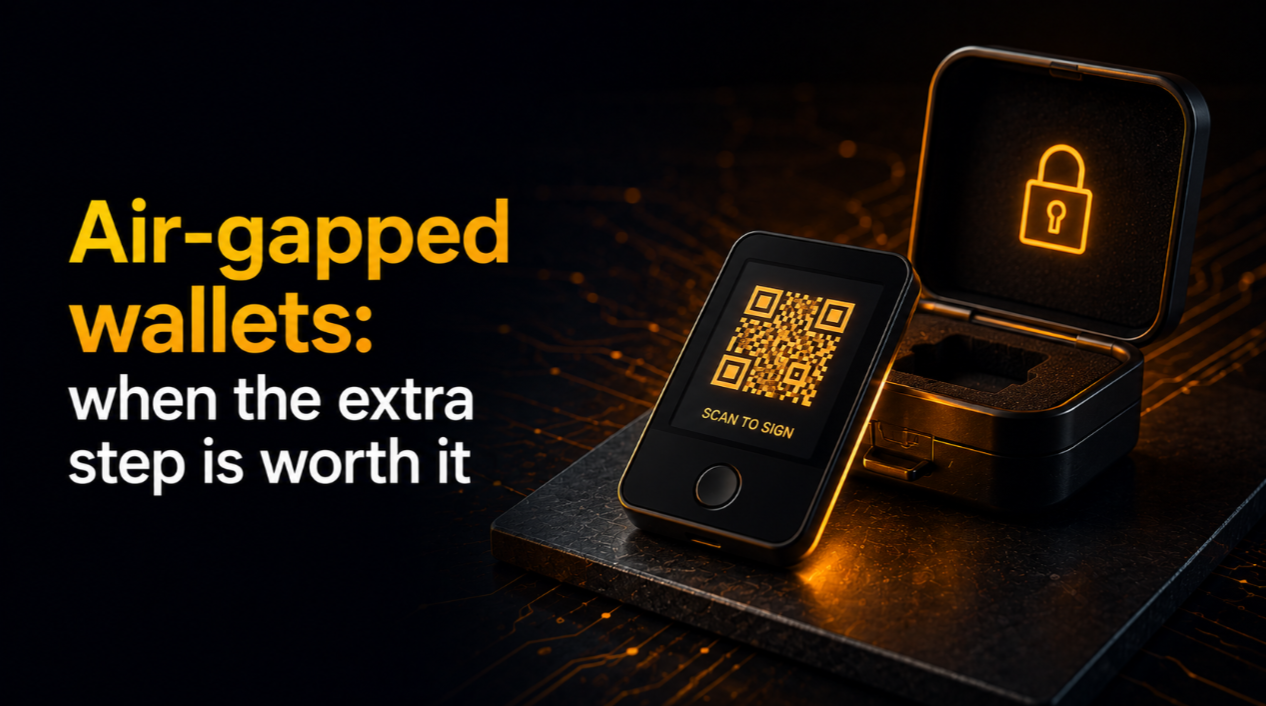
An air-gapped wallet never establishes a data connection with anything. No USB data, no Bluetooth, no Wi-Fi, no NFC. Transactions travel to and from it as QR codes shown on screens, or on a microSD card.
The claim is straightforward: if there is no data channel, there is no data channel to attack. The question worth asking is what that is actually worth relative to what it costs you in daily use.
What it removes
- USB-stack vulnerabilities. Bugs in how a device parses incoming USB data have been a genuine source of hardware-wallet flaws, and a device with no data pins has none of them.
- Wireless attack surface entirely. No Bluetooth pairing, no radio firmware, nothing listening.
- Malicious host drivers and the whole class of attacks that begin with the computer speaking to the device in an unexpected way.
The channel that remains is a QR code, which carries a bounded amount of structured data that the device parses on its own terms. That is a much smaller surface than a USB protocol stack, though it is not zero — it is still code parsing input.
What it costs
Every transaction becomes: build it on the computer, display a QR, scan it with the device, review, sign, display a QR on the device, scan it back with the computer, broadcast. Two scans, two screens, every time.
For a long-term holding you touch four times a year, that is nothing. For an account you transact from weekly, it is a real tax on your attention — and attention is the resource that stops you approving something you should not have.
Which devices actually do it
"Air-gapped" appears in a lot of marketing that means "has an optional QR mode". The test is whether a data connection exists at all.
- Keystone 3 Pro is genuinely air-gapped — no USB data path and no radios, with a large screen that makes reviewing what you are signing practical.
- SafePal S1 does the same thing for around $50, which makes air-gapping accessible at a price where it stops being a purity argument.
- Devices that connect over USB and offer a QR workflow are not air-gapped. That is not a criticism of them — Coldcard Q tops our hardware wallet rating — it is a different property.
What it does not fix
The same limitation as any hardware wallet, and it is the one that matters most: an air-gapped device signs whatever you confirm on its screen. If you approve a malicious transaction, the air gap did nothing. Air-gapping protects the channel; reading the screen protects the transaction.
It also does nothing about a badly stored recovery phrase, which is where most self-custody losses actually occur.
Who should use one
Air-gapping earns its friction for a long-term store you touch rarely and would be seriously hurt to lose. For an address you transact from regularly, a good connected hardware wallet with strong clear-signing is the better tool, because the friction you save gets spent on reading what you sign.
Air-gapping protects the channel. Reading the screen protects the transaction. Only one of those is optional.
The short version
Air-gapped signing removes the entire connected attack surface for the cost of two QR scans per transaction. That is an excellent trade for a rarely touched long-term holding and a poor one for daily use. Check that a device has no data connection at all rather than an optional QR mode — and remember it does not protect you from what you approve.
Frequently asked questions
What is an air-gapped wallet?+
A hardware wallet with no data connection of any kind — no USB data, Bluetooth, Wi-Fi or NFC. Transactions pass in and out as QR codes or on a microSD card, so there is no channel through which a connected computer can communicate with the device directly.
Is an air-gapped wallet safer?+
It removes the entire connected attack surface, including USB parsing bugs and wireless firmware, which is a genuine improvement. It does not protect you from approving a malicious transaction, which is the more common loss, and it does nothing about a badly stored recovery phrase.
Which hardware wallets are truly air-gapped?+
In our rating, the Keystone 3 Pro has no USB data path and no radios, and the SafePal S1 does the same at around $50. Devices that connect over USB and offer an optional QR workflow are not air-gapped, which is a description rather than a criticism.
Is air-gapping worth the extra steps?+
For a long-term holding you touch a few times a year, yes — the friction is negligible against the attack surface removed. For an address you transact from weekly, the two QR scans per transaction cost attention you would rather spend reviewing what you are signing.
How this was reported
ChainWatch Daily is independent and reader-funded. Stories are written by named journalists and checked against primary sources before publishing. We disclose holdings, correct errors in the open, and never accept payment for coverage.
More like this
What a hardware wallet actually protects you from
It stops a compromised computer from spending your coins. It does not stop you from approving a transaction that does exactly that.
How to choose a crypto exchange: a checklist
Seven questions, ordered by how much each one costs you if you get it wrong. Fees come sixth.
The best way to hold bitcoin long term
Not a product list. A decision tree, with the amount that justifies each step up and the failure each step actually removes.