Where should you actually keep your crypto?
Exchange, software wallet or hardware wallet — the decision is not about ideology. It is about how much you hold, how often you touch it, and what you can verify.
Originally published Aug 30, 2026

Where should you actually keep your crypto?
Keep what you are actively trading on an exchange that can prove it holds your money. Keep everything else in a wallet whose keys are yours. The line between the two is not a number somebody invented — it is the point where the annual cost of the safer option stops mattering next to what you would lose if the company holding your coins failed.
That sounds obvious. It is also the opposite of what most people do, because every part of the industry is built to keep your balance where it can earn fees on it. So this guide sets out what each option actually protects you from, using the same measurements behind our exchange rating and our hardware wallet rating.
The three options, and the risk each one removes
Every storage decision trades one risk for another. Nothing removes all of them.
- An exchange removes the risk of you losing your keys, and adds the risk of the company losing your money. You cannot verify your balance exists unless the venue publishes a proof of reserves — and most of the ones we researched either do not, or publish something that does not survive reading.
- A software wallet removes the company from the equation and hands you the keys, along with the job of protecting them. Its weak point is the device it runs on and the transactions you approve.
- A hardware wallet moves the signing step onto a device with one job, so a compromised computer cannot sign for you. Its weak point is that you can still approve something you did not read.
What an exchange actually promises
A balance on an exchange is a claim on a company. Whether that claim is backed is a question with a real answer, and most people never ask it. When we researched the custody position of 29 venues, the spread was not subtle: Kraken publishes a proof of reserves that includes total client liabilities, attested quarterly by a named accounting firm, with a personal proof each client can check their own balance against. At the other end, BitMart publishes no proof of reserves at all, and its own risk disclosure states that customer assets are covered by no compensation, insurance or protection scheme.
Both companies will happily hold your bitcoin. Only one of them lets you check it is there.
The second question is what happens after something goes wrong, and the answer is rarely what the press release said. Nearly every hacked venue promised to make users whole within days. We could only confirm it happened at a handful of them — and at BitMart, where roughly $196m was drained in 2021, reporting five weeks later and again ten months later found victims still unpaid.
When self-custody is worth the trouble
There is no universal threshold, but there is a useful test: if losing the balance would change your year, it should not sit with a company you cannot audit. A $79 device is cheaper than the fees on a single large trade, and our top-rated Bitcoin-only wallets cost less than $100.
The honest counter-argument is that self-custody moves the failure from a company to you, and people do lose money that way. The two failures that dominate are a badly stored recovery phrase and approving a transaction nobody could read. Both are solvable, and neither is solved by leaving coins on an exchange.
The setup that covers most people
For most readers, three tiers work better than one decision:
- A working balance on a licensed exchange you have checked — enough to trade with, and no more. Our exchange rating ranks 29 of them on custody evidence first, not on fees.
- A software wallet for the on-chain activity you actually do: swaps, applications, anything that needs signing regularly. Rabby simulates every transaction before you sign it and charges 0.25% on swaps against MetaMask's 0.875%.
- A hardware wallet for the part you are not touching this month. The device that wins our rating does so on one criterion above all: it shows you exactly what you are signing, every time.
What to check before you move anything
Whichever tier you are moving to, four checks catch most of what goes wrong.
- Send a test transaction first. On a small amount, on the exact network you intend to use, to the exact address. Every serious loss we have researched involved a step somebody skipped because they had done it before.
- Check the network, not just the address. The same address string on a different chain is a different destination, and support desks cannot reverse it.
- Write the recovery phrase down before funding the wallet, not after. A wallet you cannot recover is a wallet you do not own.
- Revoke old token approvals. Anything you granted a contract stays granted until you remove it — including approvals to routers that later turned out to be exploitable.
Backing is not the same as access, and a promise is not the same as a proof. Both distinctions cost people money every year.
The short version
Trade on a venue that can prove it holds your money. Hold on a device whose keys are yours. Keep the two amounts separate, and size each one so that the failure of either would be annoying rather than ruinous. Everything else in this category is detail.
Frequently asked questions
Is it safe to keep crypto on an exchange?+
It depends entirely on which exchange, and the difference is measurable. Some publish a proof of reserves that includes what they owe customers, attested by an outside accounting firm, and let you verify your own balance is counted. Others publish nothing, and at least one states in its own risk disclosure that customer assets are covered by no compensation or insurance scheme. Keep a working balance on a venue in the first group, and keep long-term holdings off exchanges entirely.
How much crypto should I move to a hardware wallet?+
There is no universal number, but a practical test is whether losing the balance would change your year. A hardware wallet costs between $59 and $200 — less than the fees on one large trade — so the cost of moving up a tier is small relative to almost any holding worth protecting.
What is the biggest risk in self-custody?+
Two things, in this order: a recovery phrase stored badly, and approving a transaction you could not read. Neither is a flaw in the concept — both have known solutions, including splitting the backup across locations and using a wallet or device that shows you exactly what a transaction does before you sign it.
Can an exchange lose my crypto even if it is not hacked?+
Yes. Custodial balances are claims on a company, and a company can fail without being breached. Public filings from at least one large exchange disclose that custodially held assets could be treated as property of the bankruptcy estate, with customers as general unsecured creditors. That risk exists at every custodian; only some of them are obliged to tell you about it.
How this was reported
ChainWatch Daily is independent and reader-funded. Stories are written by named journalists and checked against primary sources before publishing. We disclose holdings, correct errors in the open, and never accept payment for coverage.
More like this
What a hardware wallet actually protects you from
It stops a compromised computer from spending your coins. It does not stop you from approving a transaction that does exactly that.
The best way to hold bitcoin long term
Not a product list. A decision tree, with the amount that justifies each step up and the failure each step actually removes.
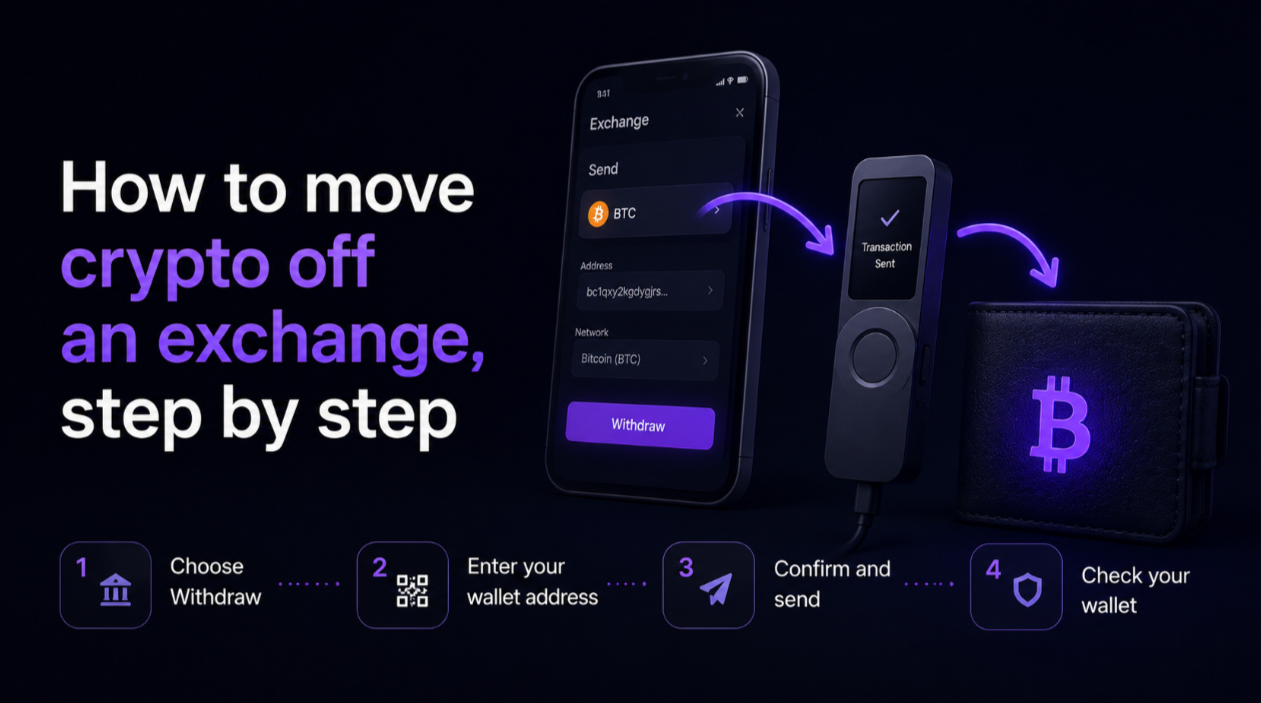
How to move crypto off an exchange, step by step
The withdrawal is the moment where irreversible mistakes happen. Five checks, in order, remove nearly all of them.